
The strongest plate-clearance opportunity isn’t always the car with the biggest advertised discount. In Australia, dealers may clear 2026 model-year vehicles before 2027 models arrive, so plate clearance car deals in Australia in 2026 can reflect a model-year change as well as an EOFY promotion. The right offer depends on the vehicle you want and the terms attached to it.
It’s understandable to focus on the headline price, especially when several plate clearance car deals in Australia appear at once. But the advertised figure alone may not show whether an offer suits your preferred model, specification or buying plans. Check what’s included so you can assess each deal on its terms.
This article explains how clearance offers work, what EOFY deals may include and how timing can affect your options. It also covers practical ways to assess an offer and compare quotes for the same new car. You’ll be better placed to decide whether a runout vehicle fits your needs or another model or purchase timeframe is a better match.
Key Takeaways
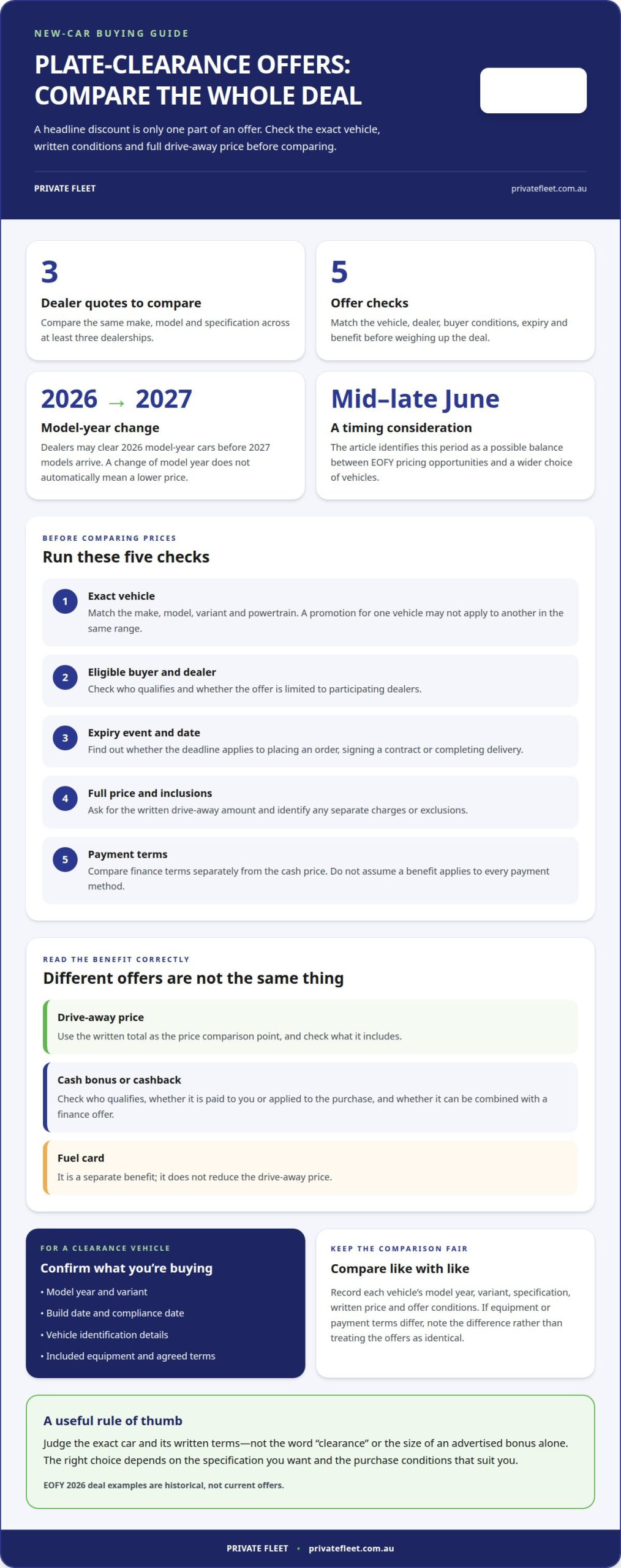
- Check which model year, variant and eligible vehicles an advertised clearance offer applies to before comparing prices.
- Compare the full drive-away price and offer conditions, not just a factory bonus or headline figure.
- Mid-to-late June can balance EOFY pricing opportunities with a wider choice of vehicles.
- Compare quotes for the same make, model and specification from at least three dealerships.
- If a price reduction isn’t available, consider whether extras such as servicing can improve the overall offer.
Offer eligibility and participating dealers
Australian new-car clearance offers are governed by their written terms, not simply the word “clearance”. Eligibility can depend on the vehicle, variant, buyer and participating dealer, so match each condition to your intended purchase before comparing offers.
For a practical comparison, record the exact model and variant, offer benefit, price basis and expiry stated in each promotion. A deal advertised for one vehicle may not apply to another, even within the same model range.
Eligibility rules and expiry dates
Offer terms specify which vehicles and buyers qualify, and when the promotion ends. Check whether the expiry applies to placing an order, signing a contract or completing delivery. Record the relevant date alongside the eligible model and variant. A pre-order price may have different conditions from a launch offer, so identify which promotion applies to your purchase.
Participating dealers matter too. An advertised offer may be limited to dealers involved in that promotion, rather than applying across every outlet selling the make. Check that the dealer’s written offer names your selected vehicle and sets out the relevant conditions. This makes the comparison meaningful and helps distinguish a specific promotion from a general driveaway price.
Conditions and fees
Australian clearance offers can include conditions on vehicle specification, buyer eligibility, payment method and participating dealer. The written quote should show the driveaway amount and any separate charges. Compare the total with the stated offer rather than assuming every cost is included. If you’re considering finance, compare its terms and total payable separately from the vehicle’s cash price.
Cash bonuses, cashback and fuel cards are different benefits. Check who qualifies, whether the benefit is paid to you or applied to the purchase, and whether it can be combined with a finance offer. A fuel card doesn’t reduce the driveaway price. A bonus may also depend on buying a specified variant, so read the conditions for that exact car.
For an electric vehicle, check whether eligibility applies to the exact powertrain and variant. For example, don’t assume an offer on one Toyota model applies to another. Use a short written checklist:
- Match the make, model, variant and powertrain.
- Record the participating dealer and qualifying buyer conditions.
- Note the promotion’s expiry event and date.
- Separate driveaway pricing from cashback, bonuses and fuel cards.
- Compare finance terms independently from the cash price.
These steps help you establish what an offer covers before committing. Keep the advertised promotion and final written quote together so you can compare the vehicle, benefit and purchase terms consistently.
EOFY model-year clearance and dealership sales targets
Australian dealers may clear 2026 model-year cars before 2027 models arrive. A change in model year can make an outgoing vehicle more prominent in EOFY discussions, but it doesn’t automatically mean a lower price. Compare the exact vehicle, its equipment and the written offer before deciding whether the price suits you.
EOFY sales targets may influence how a dealer approaches a negotiation. If a particular vehicle is a priority to sell, the dealer may consider a sharper price or additional inclusions. Treat this as a possibility, not a guaranteed saving. The outcome depends on the model, specification, offer conditions and how you plan to pay.
To check a clearance car’s build date, compliance date and model year, ask the dealer to identify each detail for the exact vehicle in writing. Make sure the offer or contract specifies the vehicle’s make, model, variant and model year, rather than relying on a general description.
These details aren’t interchangeable. A car described as a 2026 model-year vehicle may have a different build or compliance date. Compare those records alongside its specification and agreed purchase terms. For example, if two vehicles share a model name, confirm that both have the same variant and equipment before treating their offers as comparable.
Think about how long you expect to own the car and which features matter during that time. A 2026 model may suit you if its equipment meets your needs; a later model may be worth considering if its changes are important to you. The model-year label alone doesn’t show whether a particular offer represents value for your circumstances.
Payment arrangements can affect the comparison. A deposit, cash payment, finance arrangement or novated lease may have different terms. Compare the overall purchase commitment, not just a repayment or advertised premium. Check what the written price excludes, including costs or inclusions relevant to your chosen vehicle. Don’t assume a saving offered with one payment method applies to another.
Keep your comparison focused on the car and offer:
- Record the model year, variant and vehicle identification details.
- Compare the written price and included equipment.
- Read the deposit and payment terms before signing.
- Check what the offer excludes and whether finance changes its terms.
- Weigh the outgoing model’s specification against the later model.
This gives you a clear basis for discussing the exact vehicle with a dealer. If you’d like help weighing up a new-car shortlist and its purchase terms, discuss your preferred model and buying timeframe, or call 1300 303 181.
2026 Australian EOFY car deals
EOFY 2026 offers covered different vehicle types, from small hatchbacks to large SUVs and utes. Treat these examples as historical, not current offers. Their value depended on the exact variant, offer structure and purchase conditions. Compare the vehicle you wanted, rather than assuming every model from a brand shared the same deal.
Mazda’s EOFY examples included the CX-5 and CX-90 Touring. The CX-5 offer included a factory bonus, while the CX-90 Touring offer included a separate bonus. Those terms are not interchangeable: a bonus can affect the purchase calculation differently from a revised driveaway price. Buyers should compare the written total for the selected variant, including applicable on-road costs.
Other examples used different incentives. The 2026 Honda HR-V Vi X offer included a fuel card, while the Toyota bZ4X and Tundra offers included bonuses. A fuel card isn’t a reduction to the vehicle’s purchase price. An advertised bonus also doesn’t establish whether accessories, delivery charges or other costs are included. Compare each benefit against the full vehicle offer.
Variant choice matters. The EOFY deal list included manual and automatic Kia Picanto Sport variants, alongside several other distinct models. A price or incentive for one version doesn’t automatically apply to another. Before comparing offers, write down the make, model, grade, transmission and powertrain you want. Then compare the same specification across participating dealers.
Hybrid and electric offers also appeared in the 2026 list. Examples included the Hyundai Tucson Hybrid and the Toyota bZ4X electric vehicle. They suit different driving needs, so consider more than the promotion. Compare the powertrain, vehicle equipment and intended use alongside the purchase terms. A hybrid deal and an electric-car bonus aren’t direct comparisons unless both vehicles meet your requirements.
Offers can also have a defined period or eligibility rules. Some 2026 promotions were tied to dates in June, while another launch price applied by 30 June 2026. Those dates have passed. A past promotion isn’t evidence that the same offer remains available or will return. For any extended or replacement promotion, the written terms should identify the eligible model, participating dealers and expiry date.
Use this comparison when reviewing a deal:
- Match the exact model and variant.
- Separate price changes from bonuses and fuel-card benefits.
- Compare driveaway terms and included costs.
- Note the offer period and eligibility conditions.
For help weighing a new-car shortlist, share your preferred models and buying timeframe.
Timing purchases and comparing dealer quotes
A plate-clearance offer is for a new car; demonstrators and used cars aren’t like-for-like comparisons. Finance offers change how you pay, not the vehicle’s purchase price, so compare the full cost separately.
Purchase timing
Mid-to-late June can balance EOFY pricing opportunities with a wider choice of vehicles. Deals may sharpen in the last week of June, but waiting can narrow the available models or variants. Decide which specifications matter most, then weigh the offer against your delivery needs and its expiry date.
Timing also affects launch offers and delivery planning. An outgoing model may suit you if its equipment meets your needs, while a newly launched version may have changes worth considering. Compare the actual vehicle and written terms instead of relying on the word “clearance”. A demonstrator is a different proposition from a new, unregistered vehicle, so its discount isn’t a direct comparison.
Comparing dealer quotes
Request written quotes from at least three dealerships for the same make, model, variant and powertrain. Compare the driveaway total, included equipment, delivery terms and warranty conditions. A discount on one variant doesn’t establish the price of another, even within the same model range. Note each quote’s expiry and inclusions.
Separate the vehicle price from finance. Some Australian dealers advertise finance at 0%, while other examples include a 1.9% comparison rate, a 4.99% advertised loan rate and a 7.5% comparison rate including fees. These figures describe different types of rates, not interchangeable costs. Compare the total payable amount and fees against the cash price.
If a dealer won’t reduce the price, you can negotiate for 3-5 years of free servicing instead. Compare the servicing offer’s conditions and value with the price difference, rather than treating it as cash back. A fuel card is another distinct benefit, not a reduction in the vehicle’s driveaway price.
Use the same comparison points for every written offer:
- Confirm the exact vehicle, variant and model year.
- Compare driveaway pricing and included costs.
- Record delivery terms, warranty conditions and offer expiry.
- Separate any fuel card, servicing offer or finance terms.
This approach keeps a headline discount from obscuring the full deal. For help comparing a shortlist and purchase terms, share your preferred model and buying timeframe.
Use mid-to-late June as a planning window, not a reason to accept the first attractive headline. Decide in advance which vehicle details are essential and which offer terms you need to compare. If a suitable quote arrives, review its expiry, delivery terms and included equipment together. A lower figure may not help if it’s for a different specification or doesn’t suit your delivery needs.
Before choosing, put the written offers side by side and note differences in the vehicle, driveaway total, warranty conditions and extras. Ask the dealer to clarify anything that isn’t explicit, then compare the answer with the other quotes on the same basis. Keep finance, servicing and fuel-card benefits separate from the vehicle price. Choose the offer whose complete terms suit your priorities, not simply the one with the strongest headline.
When are 2026 Australian plate clearance deals offered?
EOFY 2026 clearance offers were concentrated in mid-to-late June, with deals often sharpest during June’s final week. That EOFY window has passed. For end-of-year plate clearance, timing instead depends on when a dealer clears 2026 model-year vehicles before 2027 models arrive.
There isn’t one shared clearance date for every Australian make and model. A 2027 model may arrive at a different time from another vehicle’s update, so a 2026 runout offer can appear earlier or later across ranges. The useful timing signal is the specific model-year change, not simply the calendar year’s end.
For buyers considering a 2026 vehicle now, first ask whether the offer relates to an outgoing model year or an EOFY campaign that has ended. Then compare its model year, variant and written terms with the vehicle you actually want. A past June bonus or fuel-card promotion doesn’t establish the terms of a current clearance offer.
Timing involves a practical trade-off. Acting earlier in a model-year transition may give you more choice of variants, while waiting may bring a sharper offer on a particular vehicle. This isn’t a fixed rule for every dealer. Compare the available specifications and offers, then decide whether waiting suits your preferred model and buying timeframe.
Use this simple sequence for the 2026-to-2027 changeover:
- Identify the exact make, model and variant you’re considering.
- Ask which model year the written offer covers.
- Separate current runout terms from expired EOFY promotions.
- Compare the vehicle’s specification and total driveaway price.
- Choose a purchase timeframe that suits your priorities.
That sequence helps avoid treating every “clearance” label as the same offer. For example, if a 2026 model-year vehicle remains available as 2027 models arrive, assess its equipment and price against your needs. Don’t assume the newer model automatically makes the outgoing one poor value; the actual difference depends on the vehicle and offer.
In June 2026, mid-to-late June was the suggested balance between EOFY pricing and choice. The final week could bring sharper deals, but waiting until then may limit your preferred options. That advice applies to the June EOFY period, not automatically to late-year model clearances. For a 2026-to-2027 runout, use the model’s transition and offer terms to guide your timing.
Plan around the car, not just the date. A suitable variant with clear terms may matter more than chasing the last day of a campaign. Compare the written offer with your preferred buying timeframe before committing.
Private Fleet
Private Fleet can help compare plate-clearance offers when you’ve chosen a new car and want support assessing the purchase. Its independent car buying service uses a national network of accredited dealers, inviting them to compete for your business through a formal tender. Private Fleet manages the buying process, making it easier to compare the vehicle and agreed terms.
You choose the make, model, variant and buying timeframe. Private Fleet can also assist with a trade-in or car finance as part of your purchase. The service sources your vehicle through its dealer network and provides regular delivery updates.
To discuss your preferred car and purchase timeframe, contact Private Fleet or call 1300 303 181.
Make your next car decision with confidence
Use plate clearance car deals in Australia in 2026 as a starting point, not the whole decision. Your next step is to settle on the vehicle and specification that suit your plans, then consider the written offer alongside your preferred buying timeframe. A clear shortlist makes it easier to focus on the right new-car purchase.
Private Fleet can help you source a new car through its New Car Buying Service, with Trade-In Assistance available as part of your purchase planning. Share your preferred make or model, postcode and timeframe so the team can understand what you’re looking for.
You can also call 1300 303 181 to discuss your next step. A considered choice starts with the car that fits your needs.
Frequently Asked Questions
What are the best plate clearance car deals in Australia in 2026?
There wasn’t one best deal for every buyer; the right offer depended on the vehicle and your priorities. EOFY promotions from June 2026 have passed, so archived offers shouldn’t be treated as current prices. For a 2026 model-year clearance, focus on the exact variant, its equipment and the written driveaway terms. A lower price may suit one buyer, while another may value an included benefit more.
Are plate clearance deals available across all Australian states and territories?
No, a clearance offer shouldn’t be assumed to apply throughout Australia. Its availability can depend on participating dealers, the eligible vehicle and the offer’s stated terms. For example, an advertised deal in one state may not apply to a buyer elsewhere. Compare the offer available for your postcode and consider how the stated driveaway price and inclusions relate to your location before deciding.