
The most popular Toyota isn’t automatically the right one for you. With hatches, sedans, SUVs, 4WDs, utes and vans to consider, start by narrowing the range to cars that fit your driving and day-to-day needs. If you’re searching for “buy a new Toyota Australia model selection and dealer quotes”, a focused shortlist makes it easier to compare offers on equal terms.
It’s easy to get caught between models, grades and powertrains, then wonder what each dealer’s offer includes. Think about passenger and luggage space, comfort, visibility, ease of getting in and out, and whether a hybrid or another powertrain suits your driving and access to charging.
This guide explains how to build a practical Toyota shortlist, compare written quotes on a consistent drive-away basis, and check warranty, servicing and delivery details. It also covers ordering and trade-ins, so you can make an informed decision before committing. Private Fleet is an independent Australian car buying service that works with a national network of authorised dealerships. Its tender process invites multiple dealers to compete for your business. Private Fleet doesn’t hold vehicle stock or act as a Toyota dealer.
Key Takeaways
- Start your Toyota shortlist with the job the car needs to do, your usual driving and comfort priorities, then confirm current Australian model and variant details.
- Compare model year, variant and powertrain side by side. Choose features for your needs rather than assuming a higher grade is the better fit.
- To make sense of buy a new Toyota Australia model selection and dealer quotes, request like-for-like written offers and check the drive-away basis, location, date and any expiry.
- Before ordering, review Toyota’s current warranty and servicing documents, including any separate battery warranty or capacity conditions that apply.
- Private Fleet is an independent buying service, not a Toyota dealer or stockholder. Its tender process invites multiple authorised dealers to compete for your business.
Which new Toyota models suit your needs and daily driving?
Start with the car’s role, your usual driving, comfort priorities and budget. A compact hatch may suit commuting and easier parking, while regular family trips, long-distance travel or bulky loads may point towards a larger vehicle. The best fit depends on your household and routine, not simply the model’s popularity or size.
If you’re researching “buy a new Toyota Australia model selection and dealer quotes”, first shortlist two or three models that meet your needs. Toyota Australia’s range includes hatches, sedans, SUVs, 4WDs, utes and vans. Model examples include Yaris and Corolla hatchbacks, Camry sedans, C-HR, Corolla Cross, RAV4 and Kluger SUVs, Prado and LandCruiser 4WDs, and HiLux utes. The bZ4X is an all-electric SUV. Toyota’s Australian range has changed over time; read Toyota Australia’s history for background, then check Toyota Australia’s current model information for what’s available now.
How should you narrow down the Toyota range?
Match the vehicle type to the job. For commuting, consider the car’s footprint and how easily it fits your usual parking spaces. For family use, check passenger room and whether child seats or other regular passengers fit comfortably. For regional or long-distance travel, think about the space you need and how the vehicle feels on your typical roads. If you carry larger items, measure what you actually transport and check the cargo area in person.
Before comparing grades or requesting quotes, confirm each candidate’s Australian model year, variant and powertrain. Availability and specifications can change, so don’t rely on an old listing or assume an overseas version matches the local model.
Which comfort and usability details are worth checking?
A test drive helps reveal details a specification sheet can’t settle. Adjust the driver’s seat, check visibility from your normal driving position and try getting in and out. Notice ride comfort and cabin noise on roads you commonly use. Test parking assistance and explore the controls you’ll use often, including climate, audio and navigation functions. A touchscreen or feature list matters less if the layout doesn’t feel intuitive to you.
Check safety equipment and any published safety rating against the exact Australian model year and variant. Equipment can differ across grades, so verify the specification rather than assuming every version includes the same features.
Quick shortlist checklist:
- Body style: Which type suits your regular trips?
- Seating: Who travels with you, and how often?
- Cargo: Will your usual luggage or larger items fit?
- Parking: Does the vehicle suit your garage and common parking spaces?
- Ownership period: Will it remain practical for the time you expect to keep it?
How to compare Toyota models, variants and powertrains
Compare the exact variant and powertrain against your shortlist rather than assuming a higher grade is automatically a better fit. Toyota’s Australian range and specifications can change by model year, so check the current listing for your chosen vehicle on Toyota Australia’s website before requesting quotes.
What should you compare between Toyota variants?
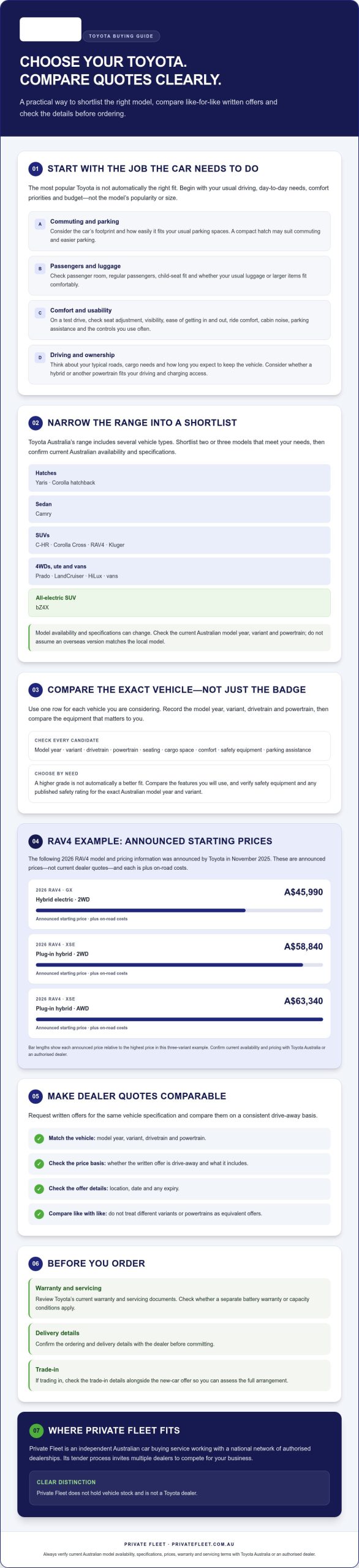
Use one row for each vehicle you’re considering. Record the model year, variant, drivetrain and powertrain, then check the equipment that matters to you, such as seating, cargo space, comfort, safety and parking assistance. The RAV4 examples below use Australian model and pricing information announced by Toyota in November 2025. Prices are shown as announced, not as current dealer quotes. Confirm availability and current pricing with Toyota Australia or an authorised dealer.
| Model | Model year | Variant | Powertrain and drivetrain | Announced starting price |
|---|---|---|---|---|
| RAV4 | 2026 | GX | Hybrid electric, 2WD | A$45,990 plus on-road costs |
| RAV4 | 2026 | XSE | Plug-in hybrid, 2WD | A$58,840 plus on-road costs |
| RAV4 | 2026 | XSE | Plug-in hybrid, AWD | A$63,340 plus on-road costs |
These examples show why it’s useful to compare drivetrain as well as grade: the XSE PHEV is listed in both 2WD and AWD configurations. Check the current Australian specification for each variant to compare its equipment and features. Separate must-haves from optional extras so you can judge whether a higher grade adds something you’ll actually use.
How do you choose a powertrain for your driving pattern?
A conventional hybrid combines a petrol engine and electric motor, but it doesn’t plug in for charging. A plug-in hybrid (PHEV) has a battery that can be charged externally as well as a petrol engine. Consider your daily and annual kilometres, longer trips and, for a PHEV, whether regular charging is practical. Check official fuel-use figures for the exact variant, and remember they’re test results, not a guarantee of real-world consumption.
For a practical buy a new Toyota Australia model selection and dealer quotes comparison, match the variant and powertrain to your needs first. Then request quotes for the same specification and verify that availability and details remain current before deciding.
How to compare new Toyota dealer quotes fairly
Compare written offers for the same Toyota, not just the largest figure on a quote sheet. Ask each dealer to price the same model year, variant, colour, accessories and delivery requirements. Then check the price basis, quote date, location and any expiry stated. This makes it clearer what each offer covers and what you need to follow up.
What should a comparable Toyota quote include?
Check that every quote identifies the vehicle and any requested accessories or optional items. Confirm whether the total is presented as a drive-away price, what it includes and whether the dealer has stated any location-specific assumptions. If an item is unclear, ask the dealer to explain it in writing rather than assuming it is included. Keep trade-in discussions separate while comparing the new-car figures, so the vehicle offers remain easy to assess.
Use a simple comparison sheet:
| Dealer | Vehicle specification | Quoted total and price basis | Inclusions | Exclusions | Quote date, location and expiry |
|---|---|---|---|---|---|
| Dealer A | Model year, variant, colour, accessories | Enter amount and stated basis | List confirmed items | List stated exclusions | Record details as quoted |
| Dealer B | Model year, variant, colour, accessories | Enter amount and stated basis | List confirmed items | List stated exclusions | Record details as quoted |
How can you assess different dealer responses?
Read the complete written offers, including conditions, rather than relying on a headline total. A lower figure may not be directly comparable if the vehicle, accessories or price basis differs. Note whether an offer has an expiry, and contact the dealer to confirm current availability or ordering details before making plans. Don’t assume an indicative quote guarantees a vehicle or delivery timing.
Keep your comparison factual. Unless supported by current, verifiable evidence, don’t treat any example price or claimed saving as typical. The table is there to reveal differences and prompt useful questions, not predict what another buyer will be offered. For a clear buy a new Toyota Australia model selection and dealer quotes process, settle the vehicle specification first, then assess each dealer’s written response against the same checklist. For a broader overview of the best way to buy a new car in Australia, compare the buying approaches and what to check before committing.
What to check before ordering a new Toyota
Before committing, make sure the order reflects the Toyota you selected and that you understand the relevant warranty, servicing, trade-in and delivery arrangements. Warranty and servicing terms can vary by vehicle and change over time, so check the documents that apply to your exact model year, variant and powertrain before signing.
How should you assess warranty and servicing?
Use the current Australian warranty booklet and servicing schedule published by Toyota Australia. Check the cover period, exclusions, conditions, servicing requirements and transferability stated in the documents. For a hybrid or battery electric vehicle, look separately for the traction-battery warranty and any capacity guarantee. Don’t assume battery terms are identical to the vehicle warranty or apply across every Toyota.
Record the document titles and the date you checked them, then keep copies with your order paperwork. Confirm which scheduled services apply to your exact vehicle and review any capped-price servicing terms in the current Toyota information. If a dealer describes a warranty or servicing benefit, ask them to identify the written terms that apply to your order.
What should you clarify about trade-in and delivery?
Keep the trade-in valuation separate from the new Toyota quote so you can assess each figure clearly. Ask how the valuation was reached, whether it depends on an inspection and whether any conditions apply. This helps you distinguish the cost of the new vehicle from the amount offered for your current car.
Before signing, check that the order names the correct model, variant, colour and accessories, and clearly states the agreed price basis, deposit terms and any conditions. Ask who will provide order updates and what to expect at handover. Confirm estimated timing and delivery arrangements with the dealer, and treat dates as estimates unless confirmed for your specific order.
To assess likely ownership costs, use your own expected annual kilometres and ownership period. Consider servicing, fuel or charging, tyres, insurance and registration. Treat future resale as an estimate, not a guarantee. These checks can help you decide whether the vehicle and its ongoing costs fit your plans.
See how the new-car buying process works
How Private Fleet can help you source a new Toyota
Private Fleet is an independent Australian car sourcing and buying service, not a Toyota dealer and not a holder of vehicle stock. It works with a national network of authorised dealerships. Through its tender process, multiple dealers are invited to compete for your business, giving you offers to review against your chosen Toyota and requirements.
This can bring structure to the steps between settling on a shortlist and deciding which offer, if any, suits you. It doesn’t mean a particular model will be available, that a specific price will be offered or that you’re obliged to proceed. Confirm availability, quote details and ordering arrangements with the relevant dealer.
What information helps start a Toyota search?
Share your preferred model and variant if you’ve settled on one, or provide a shortlist if you’re still weighing up options. Clear requirements make it easier to compare responses for the same vehicle rather than receive offers for different specifications.
Include your postcode and intended buying timeframe. You can also mention your preferred colour or accessories, any must-have features and whether you’re considering a trade-in. If you’re unsure which variant fits, outline how you’ll use the car, such as commuting, family travel or carrying larger items. Finance doesn’t need to lead the conversation. First establish the vehicle and quote details you want to assess.
What happens after you share your shortlist?
Private Fleet uses the information you provide to approach dealers in its authorised-dealership network. The tender invites multiple dealers to compete for your business. You can then review the responses and compare the proposed vehicle, quoted price basis, inclusions, conditions and any stated timing before deciding how to proceed. Ask for clarification if offers differ or an item isn’t clear.
The dealer remains responsible for confirming vehicle availability, the final order terms and delivery arrangements. Private Fleet doesn’t guarantee a particular quote or delivery date, and you remain in control of whether to accept an offer. To see the steps in more detail, read about how the new-car buying process works.
For a focused buy a new Toyota Australia model selection and dealer quotes enquiry, share your preferred Toyota model or shortlist, postcode and buying timeframe. Add any relevant variant preferences or trade-in plans so the request reflects what you’re looking for.
Take your Toyota shortlist forward with confidence
A clear shortlist makes it easier to choose a Toyota that suits your everyday driving, comfort preferences and budget. Once you’ve settled on the model, variant and powertrain, compare written dealer quotes for the same vehicle and price basis. Before ordering, check current warranty and servicing terms, clarify trade-in arrangements, and confirm order and delivery details directly with the dealer.
If you’re ready to buy a new Toyota Australia model selection and dealer quotes, Private Fleet can help you explore dealer responses for your preferred vehicle. Founded in 1999, Private Fleet is an independent Australian car buying service that works with a national network of authorised dealerships. Its tender process invites multiple dealers to compete for your business. Private Fleet isn’t a Toyota dealer and doesn’t hold vehicle stock, and you decide whether to proceed with an offer.
Share your preferred Toyota or shortlist, postcode and buying timeframe to help frame your enquiry. You can take the next step at your own pace, with the details in writing before you commit.
Get help buying my new car
A considered comparison can make your next decision clearer and more manageable.
Frequently Asked Questions
Which Toyota should I buy in Australia?
Choose the Toyota that best matches your regular driving, passenger and cargo needs, comfort preferences and budget. A smaller car may suit commuting and easier parking, while an SUV or larger vehicle may better fit your household or luggage. Consider how long you expect to own it, too. Compare a shortlist in person where possible, then confirm current Australian model availability, variant features and specifications with Toyota Australia or a dealer.
How do I compare new Toyota dealer quotes?
Ask for written quotes for the same model year, variant, colour, accessories and delivery requirements. Compare the stated price basis, total, inclusions, exclusions, quote date, location and any expiry. Ask the dealer to clarify unclear items in writing, and confirm availability or ordering details directly. If you’re researching “buy a new Toyota Australia model selection and dealer quotes”, this like-for-like approach helps you assess complete offers rather than headline figures alone.
What does a Toyota drive-away quote include?
A drive-away quote is intended to state the total payable to purchase and take delivery of the vehicle, but check exactly what the dealer has included. The amount and components can depend on the vehicle, location and quote. Request an itemised breakdown and ask whether registration, compulsory third party insurance, stamp duty, accessories or other charges are included or excluded. Confirm the quote’s validity and any conditions before comparing it with another offer.
Can I get a new Toyota quote without visiting a dealership?
You can ask an authorised dealer whether they’ll provide a written quote remotely, and clarify if a visit is needed later to finalise the order or handover. Private Fleet is an independent Australian car buying service, not a Toyota dealer or vehicle stockholder. Its tender process invites multiple authorised dealers to compete for your business. You can share your preferred model, postcode and buying timeframe to help frame an enquiry without first visiting a dealership.
Is a Toyota hybrid the same as a plug-in hybrid?
No. A conventional hybrid, often called an HEV, combines a petrol engine and electric motor and doesn’t plug in for charging. A plug-in hybrid, or PHEV, has a battery that can be charged externally as well as a petrol engine. Check which powertrains are currently offered for the specific Toyota model and variant you’re considering. For a PHEV, consider whether you can charge regularly and compare official figures carefully with your own driving needs.
What should I check before ordering a new Toyota?
Confirm the order shows the correct model year, variant, colour, accessories and agreed price basis. Read Toyota’s current warranty booklet and servicing schedule for that vehicle, including applicable conditions, exclusions and any separate battery terms. Keep a trade-in valuation distinct from the new-car quote while comparing offers. Ask the dealer to explain order terms, updates and delivery arrangements in writing, and treat estimated timing as subject to confirmation for your order.