
What if the best powertrain for your new car isn’t the one with the biggest electric range, but the one that fits your weekly routine? If you’re asking, “EV vs PHEV vs hybrid Australia: which powertrain should I buy?”, the answer depends on where you can charge, how far you drive and how often you take longer trips.
It’s easy to mix up the options. A battery electric vehicle (EV) needs plugging in, a plug-in hybrid (PHEV) can drive on electricity and petrol, and a conventional hybrid uses petrol with electric assistance but doesn’t plug in. Each can make sense for a different routine, so there’s no single best choice for every Australian driver.
This guide will help you match each powertrain to your driving and charging habits, then compare new-car models and variants more confidently. You’ll see what to consider when weighing advertised range and fuel consumption, home and public charging, longer journeys, towing needs, warranty and your intended ownership period. By the end, you’ll have a clearer way to narrow your shortlist without getting lost in specifications.
Key Takeaways
- Decide whether plugging in suits your routine before comparing advertised range or fuel-use figures.
- Understand the difference between a plug-in hybrid, a conventional hybrid and a mild hybrid to narrow your options.
- Use your charging access, daily and annual kilometres, long-trip needs and ownership plans to answer: “EV vs PHEV vs hybrid Australia: which powertrain should I buy?”
- Build a practical shortlist by setting your budget, vehicle size and preferred features, then compare Australian models and variants.
- Once you’ve chosen a powertrain, Private Fleet can source new-car options through its authorised-dealership network, where multiple dealers are invited to compete for your business.
EV vs PHEV vs hybrid: what each powertrain means for Australian buyers
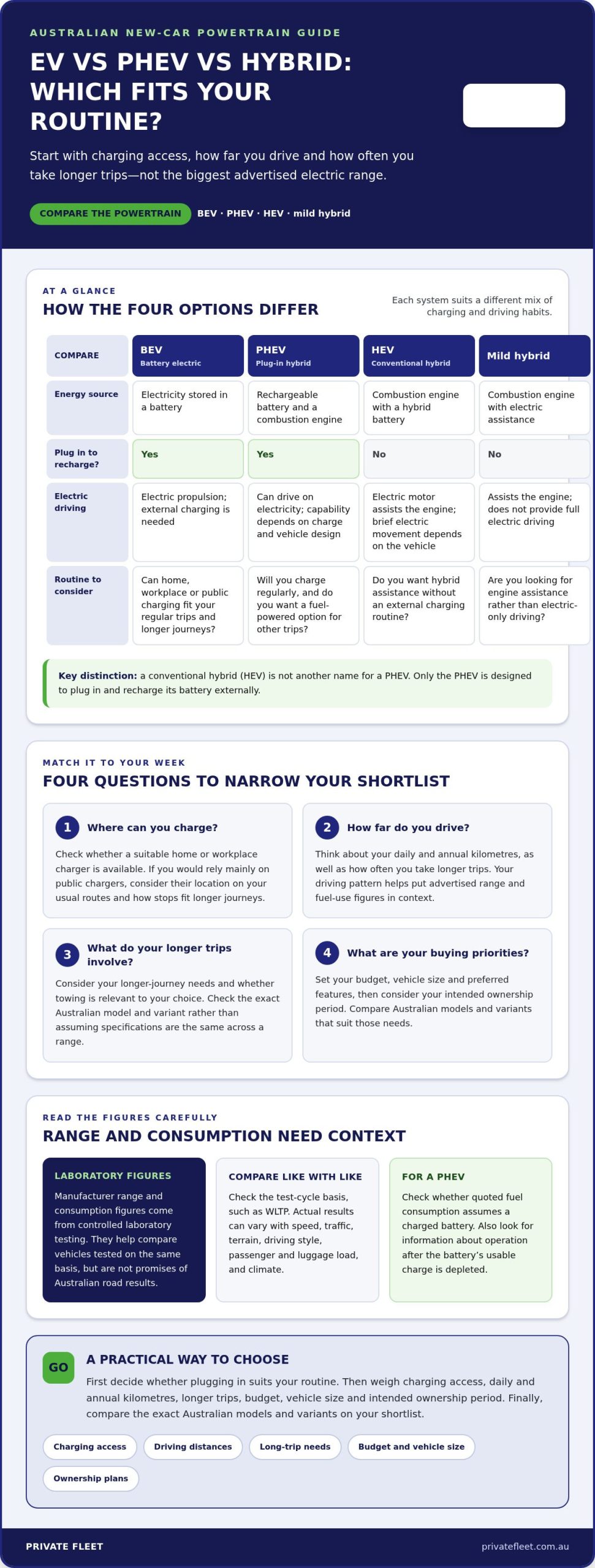
The right choice depends on your access to charging and the way you drive. For this comparison, “EV” means a battery electric vehicle (BEV): it uses electric propulsion and must be plugged in to recharge. A plug-in hybrid (PHEV) combines a rechargeable battery and electric motor with a petrol or other combustion engine. A conventional hybrid (HEV) and a mild hybrid also pair electric components with a combustion engine, but neither is a plug-in vehicle.
So, EV vs PHEV vs hybrid Australia: which powertrain should I buy? Start by asking whether you want a car that runs only on electricity, one that can use electricity and fuel, or one that manages its electrical assistance without plugging in.
| Powertrain | Power source | Plug-in charging? | Typical buyer fit |
|---|---|---|---|
| BEV | Electricity stored in a battery | Yes | Drivers whose charging routine suits an all-electric car |
| PHEV | Rechargeable battery and combustion engine | Yes | Drivers who can charge and want a fuel-powered option for other trips |
| HEV | Combustion engine and hybrid battery | No | Drivers seeking hybrid assistance without external charging |
| Mild hybrid | Combustion engine with electric assistance | No | Drivers wanting engine assistance, not electric-only driving |
How a BEV differs from a PHEV
A BEV stores electricity in a battery and uses an electric motor to drive the car. It needs charging from an external power source. A PHEV also has a battery that can be charged by plugging in, but it carries a combustion engine too. That gives it two ways to draw on energy, although the balance depends on the vehicle and how it’s used.
A PHEV’s electric driving depends on its battery charge and vehicle design. Its engine can contribute when the battery’s charge is depleted or driving conditions call for it. The broad term hybrid vehicle covers several different arrangements, so check the exact powertrain rather than relying on a badge or the word “hybrid” alone.
What conventional and mild hybrids do
An HEV manages its smaller battery through the vehicle’s powertrain, including energy recovered during braking. You don’t plug it in. Its electric motor works alongside the engine, and whether it can briefly move under electric power depends on the particular vehicle.
A mild hybrid also uses electric assistance with a combustion engine, but its motor supports the engine rather than providing full electric driving. Crucially, a conventional hybrid is not another name for a PHEV: only the PHEV is designed to plug in and recharge its battery externally.
These labels describe the basic systems, not a guarantee of how a car will perform in your routine. Within each category, battery size, vehicle design and driving conditions matter. In the next comparison, look beyond the badge to understand how charging, range and fuel use apply to the Australian model and variant you’re considering.
How charging, range and fuel use differ across EVs, PHEVs and hybrids
The main day-to-day difference is where the energy comes from. A battery electric vehicle (BEV) needs electricity from a charger, while a conventional hybrid (HEV) and a mild hybrid use petrol or another combustion fuel with electric assistance. A plug-in hybrid (PHEV) can use both external electricity and fuel, so its results depend partly on how often you charge it.
| Powertrain | How it gets energy | What to consider in use |
|---|---|---|
| BEV | Electricity from charging | Plan charging around home, workplace or public access, especially on longer trips. |
| PHEV | Electricity when charged, plus fuel | Compare regular charged use with driving after the battery charge is depleted. |
| HEV | Fuel, with energy managed by the hybrid system | Refuel as needed; no plug-in charging routine is required. |
| Mild hybrid | Fuel, with electric assistance | Refuel as needed; electric assistance does not replace the engine for driving. |
What charging access changes
Regular access to a suitable home or workplace charger can make it easier to charge a BEV or PHEV as part of your routine. If you’d rely mainly on public chargers, consider where they are along your usual routes and how charging stops would fit into longer journeys. That planning matters more when the car depends on charging for its everyday energy.
For a PHEV, plugging in regularly allows you to make use of its electric driving capability. If you rarely charge, more of your driving will rely on the combustion engine, changing the balance of energy use. Explore Australian electric vehicle articles for related EV topics.
Why published range and consumption need context
Manufacturer range and consumption figures come from controlled laboratory testing. They’re useful for comparing vehicles tested on the same basis, but they aren’t promises of what you’ll achieve on Australian roads. Check the test-cycle basis, such as WLTP, and compare like with like. Actual results can vary with speed, traffic, terrain, driving style, passenger and luggage load, and climate.
PHEV figures need an extra check: note whether the quoted fuel consumption assumes a charged battery, and look for information about operation after the battery’s usable charge is depleted. A charge-weighted PHEV figure reflects a mix of electric and fuel-powered driving under test assumptions. It isn’t directly comparable with an HEV fuel-consumption figure, which doesn’t rely on plugging in.
For a fair comparison, record each Australian model and variant’s stated range or consumption, test basis and battery-charge assumptions. Then consider how closely those assumptions match your usual trips and charging routine.
Which powertrain suits your Australian driving routine?
There’s no universal winner. The useful question is whether charging fits your week, what your usual trips look like and how often you travel beyond them. To answer “EV vs PHEV vs hybrid Australia: which powertrain should I buy?”, consider your routine across a typical week, not just your longest annual holiday drive.
When an EV, PHEV or hybrid may fit
Consistent access to charging at home or work can make an EV easier to build into everyday life, particularly if most trips follow familiar routes. A PHEV may suit a different pattern: you can charge regularly for shorter journeys but also value a petrol engine for longer or less predictable travel. If plugging in is impractical, a conventional hybrid offers electric assistance without adding a charging routine.
Distance matters, but it doesn’t decide the answer on its own. A driver covering modest distances may still prefer a hybrid if charging is inconvenient; someone driving further may consider an EV if charging access and trip planning work for them. Think about your expected annual kilometres and intended ownership period, then compare the likely routine with the exact model’s specifications and warranty terms.
| Your routine | Options to consider | Main trade-off |
|---|---|---|
| Regular local trips and reliable home charging | EV, or PHEV if you also want a combustion engine | An EV depends on charging access; a PHEV’s use of electricity depends on charging it regularly. |
| Mixed commuting and frequent longer drives | PHEV or conventional hybrid | A PHEV adds charging to the routine; an HEV doesn’t provide plug-in electric driving. |
| Regional travel with limited charging access | Conventional hybrid, or a PHEV suited to your routes | Plan around available charging for plug-in options; compare the exact car’s range and fuel-use details. |
| Long trips with dependable charging stops | EV, PHEV or hybrid | Compare route planning and stops for an EV with the refuelling needs and driving pattern of the alternatives. |
| Towing is a regular requirement | Any powertrain only if the specific vehicle suits the job | Verify the exact Australian variant’s rated towing limits and other relevant load specifications. |
Test the decision against real-life needs
Before settling on a powertrain, list your daily kilometres, annual distance, usual passenger load and the longer journeys you make. Include occasional needs too, such as carrying grandchildren or taking luggage on regional trips. These details help you judge whether a vehicle’s space and charging or refuelling routine will remain practical over the period you expect to own it.
Then assess the car itself. Check seat comfort and adjustment, ease of entry and exit, visibility, ride comfort and cabin noise on a test drive. Try the controls you’ll use regularly, including climate settings and navigation, and consider whether the parking assistance suits your usual spaces. Compare the same criteria across your shortlist rather than assuming a particular powertrain guarantees a more comfortable car.
Once you have a preferred powertrain and a few suitable variants, share your shortlist, postcode and buying timeframe to get help with your new-car purchase.
How to compare new Australian EV, PHEV and hybrid models
Once you’ve settled on a powertrain, compare cars that meet the same needs rather than matching badges alone. Start with your budget and the type of vehicle you want, then check that each model is currently available in Australia in the variant you’re considering. The answer to “EV vs PHEV vs hybrid Australia: which powertrain should I buy?” is more useful when the shortlist reflects your real priorities, not just headline range or fuel-use figures.
Use this checklist to set your comparison boundaries:
- Budget: Set a maximum in A$ and compare drive-away offers on the same basis.
- Size: Choose the body style, passenger space and luggage capacity that fit your usual trips.
- Charging: Note whether you can charge at home or work, or would rely on public charging.
- Routine: Consider daily and annual kilometres, regular longer journeys and any towing needs.
- Features: Prioritise the comfort, technology and safety features you’ll use regularly.
Then make a like-for-like table. Record the Australian model year, exact variant and powertrain for each candidate. Models in the same broad category may differ in size, equipment and price, and there may not be a direct equivalent across powertrains. Compare vehicles within overlapping size and price segments only after checking current Australian availability against manufacturer or authorised-dealer information.
| What to record | How it helps |
|---|---|
| Model year, variant and powertrain | Keeps the comparison tied to the exact Australian vehicle. |
| Drive-away price, location and offer expiry | Shows whether quotes are current and based on comparable terms. |
| Range or consumption and test basis | Provides context for interpreting published figures. |
| Warranty and servicing terms | Helps you assess support over your planned ownership period. |
Build a shortlist around the whole vehicle
Powertrain matters, but so does how the car feels and works for you. During a test drive, assess seat adjustment, entry and exit, visibility, ride comfort and cabin noise. Try the touchscreen and physical controls you’d use often, rather than judging the interface from a brochure. Check parking assistance and safety features against the specifications for the exact Australian variant, as equipment can differ within a model range.
Check specifications and ownership information
Use Australian manufacturer specifications, warranty booklets and servicing schedules. Record the date you checked them so you can revisit details if terms change. Separate the vehicle warranty from any battery warranty, and read the conditions, exclusions and transferability terms. For a battery capacity guarantee, note the stated threshold and the conditions that apply; don’t assume it’s the same as general vehicle cover.
For current model and variant information, Private Fleet’s new-car buying service supports buyers comparing new-car options. As you refine your shortlist, keep your preferred variant and buying timeframe alongside the specifications and offer details you’ve gathered.
Turn your powertrain shortlist into a confident new-car purchase
Once you’ve matched a powertrain to your routine, move from broad research to a defined shortlist. Choose the powertrain, select the Australian model and variant that meet your needs, verify the current specifications and terms, then compare like-for-like offers. This keeps the purchase focused on the car you actually want, rather than on a headline price or a range of options that don’t fit.
Prepare details that make a shortlist useful
Before starting the buying process, bring together the practical details that shaped your choice. A preferred make or model is helpful, but it’s also useful to set a realistic budget and explain how you expect to use the car. Include:
- Your charging access at home or work, if relevant.
- Your usual weekly driving routine and estimated annual kilometres.
- Longer-trip or regional travel needs, plus any regular passenger or luggage requirements.
- Your preferred model, variant or vehicle size, and buying timeframe.
- Your postcode, which helps make a new-car offer relevant to your location.
With these details, you can compare variants against the same needs, then review drive-away offers on a consistent basis. Check what each offer covers, where it applies and when it expires. If you’re considering a trade-in, treat its value separately from the new-car price so the figures remain clear.
For an overview of the steps from choosing a vehicle to purchase, see how the new-car buying process works. You can also explore new-car buying support as you move from a powertrain decision to comparing suitable options.
Get support comparing the next steps
Private Fleet is an independent Australian vehicle sourcing and car buying service. It works with a national network of authorised dealerships and uses a tender process that invites multiple dealers to compete for a buyer’s business. Private Fleet sources vehicles through this network; it doesn’t hold its own vehicle inventory. Dealer competition can support your comparison, but it isn’t a promise of a particular price or saving.
If you’re asking, “EV vs PHEV vs hybrid Australia: which powertrain should I buy?”, use the answer you’ve reached to guide the purchase, not to rush it. Share your preferred make or model, postcode, budget, annual kilometres, charging access and buying timeframe so the support can be tailored to your shortlist. Trade-in assistance may also be relevant if you’re replacing a car, while finance can be considered separately from choosing and sourcing the vehicle.
Take your shortlist from research to the right fit
“EV vs PHEV vs hybrid Australia: which powertrain should I buy?” isn’t a question with one answer for every driver. Your next step is to choose the option that best matches your charging access and regular travel, then focus on the specific new-car variants that fit your budget and priorities.
Before comparing offers, narrow your shortlist to a manageable number of vehicles. Check that each one suits your routine, then compare current drive-away terms for your postcode and buying timeframe. A clear shortlist makes it easier to weigh the actual vehicle and offer, rather than getting caught up in specifications that matter less to your needs.
If you’d like support with the next stage, Private Fleet can help you progress from a preferred powertrain to sourcing a new car. Share your preferred make or model, budget, annual kilometres, charging access, postcode and intended buying timeframe to help shape the discussion.
With a practical shortlist and the right details at hand, you can move towards your next car with greater clarity and confidence.
Frequently Asked Questions
Can I own an EV in Australia if I cannot charge at home?
Yes, but you’ll need a workable alternative charging routine. Before choosing an EV, map public chargers near places you regularly visit and along your usual longer routes, then consider how often you’d need to stop. If you live in an apartment or use shared parking, check whether workplace or nearby public charging fits your schedule. The EV vs PHEV vs hybrid choice in Australia depends partly on whether that routine feels practical for you.
Do official EV range figures show how far I will drive in real life?
No. An official range figure is a test result, not a guarantee of the distance you’ll achieve on every trip. Before comparing new cars, check which test cycle the Australian specification uses and compare figures measured on the same basis. Then consider your likely speeds, traffic, route, load and climate. If a regular journey is close to the stated range, allow for variation rather than assuming the test figure will match your experience.
Does a PHEV use more fuel when its battery is not charged?
It can use more fuel when you’re driving without a charged battery, because the combustion engine then does more of the work. The result varies by vehicle and driving conditions, so look for the manufacturer’s fuel-consumption information for battery-depleted operation. If you’re considering a PHEV, think about how often you can charge and whether the car still suits your routine when plugging in isn’t possible.
Can I tow with an EV, PHEV or hybrid in Australia?
Some vehicles in each category may be rated to tow, but the powertrain type alone doesn’t tell you whether a particular car can handle your load. Check the Australian specification and owner’s manual for the exact model year, variant and configuration. Compare the relevant towing limits with your trailer or caravan requirements, including any applicable limits for the loaded vehicle. Don’t assume a rating for one variant applies to another.
Is a PHEV still usable if I cannot plug it in for a while?
Generally, yes. A PHEV has a combustion engine as well as its rechargeable battery, so it can continue to be driven when you can’t plug in. However, fuel use and the way the car operates may differ from your usual charged routine. If a break from charging is likely, check the manufacturer’s guidance for operating the vehicle with a depleted battery and consider how often that situation might occur.
Should I compare a PHEV’s fuel figure with a hybrid’s figure?
Not without checking the assumptions behind each figure. A PHEV’s combined or charge-weighted fuel result may assume a mix of electric driving and engine use after charging. A conventional hybrid’s figure doesn’t rely on plugging in. For a useful comparison, identify the PHEV’s battery-charge assumptions and look for its fuel-use information when the battery’s usable charge is depleted. Don’t treat those test results as directly equivalent.
What should I check about battery warranty when comparing new cars?
Read the warranty booklet for the exact Australian model and variant. Check the battery warranty period and distance limit, whether it includes a minimum capacity guarantee, and the threshold and conditions that apply. Review exclusions, servicing requirements and whether coverage transfers to a subsequent owner. Keep battery coverage separate from the vehicle warranty in your comparison, as the terms and covered components can differ. Record the date you checked the documents.