
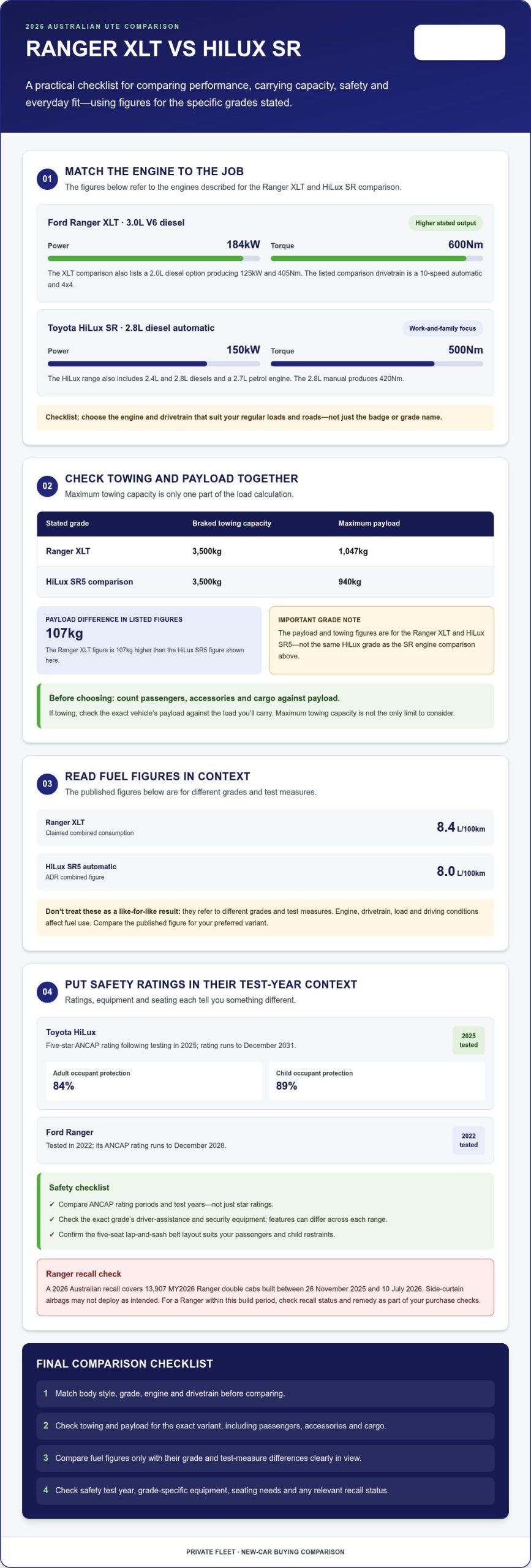
The 2026 Ford Ranger XLT suits buyers who value strong diesel performance and a more comfortable ride, while the Toyota HiLux SR is a practical choice for buyers prioritising a straightforward work-and-family ute. In the Ford Ranger versus Toyota HiLux 2026 Australia comparison, the Ranger’s 3.0-litre V6 produces 184kW and 600Nm, while the HiLux’s 2.8-litre diesel automatic produces 150kW and 500Nm.
Choosing between them isn’t just about engine figures. The right fit depends on how you’ll use the ute, which features matter day to day and how the full purchase price compares for your preferred variant.
This guide focuses on the Ranger XLT and HiLux SR, comparing relevant grades, towing, safety, family comfort and pricing considerations. You’ll get a clearer sense of which ute suits your driving, carrying and ownership needs, without treating the two line-ups as identical.
Key Takeaways
- Match the Ranger XLT and HiLux SR by drivetrain and equipment, not just badge or grade name.
- Compare engine output and towing capacity for the exact variant you’re considering, then account for payload when carrying passengers or gear.
- Look beyond safety features: the models were tested in different years, so consider each ANCAP rating in that context.
- Assess rear-seat access, comfort and everyday usability for your passengers, including on longer trips.
- Compare the full drive-away offer for your preferred specification, then weigh it against the features and ownership priorities that matter most to you.
Ford Ranger vs Toyota HiLux in 2026: which ute should you buy?
For Australian buyers comparing the 2026 Ford Ranger and Toyota HiLux, start by matching the grade, engine and drivetrain to your regular use. The two ranges offer different engine and body-style choices, so compare the available options against your regular use. Compare similar cab styles and equipment to make the differences meaningful.
Engine and drivetrain options
The Ranger’s 2.0-litre turbo-diesel produces 125kW and 405Nm; its 3.0-litre V6 turbo-diesel delivers 184kW and 600Nm. The 2026 XLT comparison lists both diesel engines, a 10-speed automatic and 4×4. The Ranger range also includes a plug-in hybrid, a distinct option for buyers considering an electrified ute.
HiLux engine choices include 2.4-litre and 2.8-litre diesels and a 2.7-litre petrol engine. The 2.8-litre produces 150kW and 500Nm with an automatic, or 420Nm with a manual. The range also includes a 48-volt V-Active system and an electric 4×4 option. Match the exact engine and drivetrain to your expected loads and roads.
Fuel consumption figures
The Ranger XLT’s claimed combined fuel consumption is 8.4L/100km. The HiLux SR5 automatic has an ADR combined figure of 8.0L/100km. These figures refer to different grades and test measures, so they don’t establish the consumption of every model in either range.
Engine, drivetrain, load and driving conditions affect fuel use. Compare the published figure for your preferred variant, especially if weighing a 2.0-litre Ranger against a V6 or a HiLux SR against an SR5.
Towing capacity and payload
The Ranger XLT has a maximum braked towing capacity of 3,500kg and maximum payload of 1,047kg. The HiLux SR5 comparison lists 3,500kg braked towing capacity and 940kg maximum payload. These figures apply to those grades, not every ute in each range.
Passengers, accessories and cargo all count towards payload. If you plan to tow, compare the exact vehicle’s payload with the load you’ll carry. Maximum towing capacity isn’t the only limit to consider.
Warranty and maintenance plans
The Ranger XLT has a five-year, unlimited-kilometre vehicle warranty. Since 1 September 2026, a seven-year, unlimited-kilometre warranty applies when servicing within Ford’s dealer network. The HiLux servicing schedule is every six months or 10,000km, whichever comes first.
Compare the service interval and relevant warranty conditions alongside the vehicle specification.
| Option | Engine and drivetrain | Consumption figure | Towing and payload |
|---|---|---|---|
| Ranger XLT | 2.0L or 3.0L diesel; 10-speed automatic; 4×4 comparison | 8.4L/100km claimed combined | 3,500kg braked; 1,047kg payload |
| HiLux SR5 automatic | 2.8L diesel; automatic | 8.0L/100km ADR combined | 3,500kg braked; 940kg payload |
Choose by matching the exact grade’s drivetrain, fuel use and carrying capacity to your everyday driving and towing needs.
ANCAP safety ratings and equipment
The HiLux and Ranger have ANCAP ratings from different test years. Compare each result with the equipment fitted to your preferred grade. The rating, seat layout and driver-assistance specification each provide a different part of the safety picture.
ANCAP safety ratings
The Toyota HiLux received a five-star ANCAP safety rating after testing in 2025, and its rating runs to December 2031. The Ford Ranger was tested in 2022, with its rating running to December 2028. The HiLux’s ANCAP scores include 84% for adult occupant protection and 89% for child occupant protection.
Those results provide specific information to consider, but the different test years matter when interpreting the comparison. Look at the rating period and the occupants you regularly carry. For family use, pay close attention to child occupant protection and how the seating and restraints suit your passengers.
Safety and driver assistance
The Ranger XLT and HiLux SR comparisons list lap-and-sash seatbelts for five seats. This establishes the stated restraint layout, but not a complete list of driver-assistance functions for either grade. Equipment can vary across a model range, so compare the exact XLT and SR specifications rather than assuming features from another grade are included.
List the assistance functions that matter for your driving, then assess how each vehicle presents alerts and controls. If you regularly tow, consider trailer use when assessing the vehicle’s assistance systems. A clear, grade-specific comparison helps distinguish standard equipment from features offered elsewhere in either range.
Safety and security features
Check safety and security equipment against the exact model year, grade and body style you intend to buy. The XLT and SR are specific comparisons; equipment on other Ranger or HiLux variants may differ. Confirm that the five-seat layout suits your passengers, and compare the driver-assistance and security functions relevant to your everyday journeys.
A 2026 Australian recall covers 13,907 MY2026 Ford Ranger double cabs built between 26 November 2025 and 10 July 2026, because side-curtain airbags may not deploy as intended. For a Ranger within that build period, make recall status and the remedy part of your purchase checks.
Keep the decision focused on the vehicle, not just its nameplate. For each candidate, check its ANCAP test year and rating period, grade-specific equipment and seating arrangement. Then consider how these details match your passengers, regular routes and towing plans. Weigh the HiLux’s five-star result and the Ranger’s separate test year in context, rather than treating them as identical assessments.
- Rating: compare each model’s ANCAP result and test year.
- Passengers: consider the HiLux’s adult and child occupant scores for your household.
- Grade: assess the safety equipment listed for the exact XLT or SR.
- Recall: include the stated Ranger build period in your checks.
This makes the safety comparison more useful by connecting the published rating and equipment to the particular ute you plan to drive.
Price and grade comparisons at similar budgets
For the 2026 Ranger and HiLux, compare the same cab style, drivetrain and equipment before weighing the total purchase amount. Grade names don’t guarantee equivalent specifications: the Ranger XLT comparison is a 4×4, while the listed HiLux SR comparison is rear-wheel drive. A Victorian drive-away listing also reflects a particular vehicle configuration and location, so it shouldn’t be treated as a national price.
To answer the price question by grade, the useful comparison is the full drive-away offer for each exact variant. The amount changes with grade, engine, drivetrain, cab style and registration location. Compare the Ranger XL, XLT and Sport with HiLux WorkMate, SR and SR5 only after matching those details. The GR Sport and electrified variants are different propositions, not automatic equivalents to a diesel XLT or SR.
Use this sequence to build a fair shortlist:
- Choose the cab style and drive layout you need.
- Match engine and transmission, including whether you want diesel, petrol or an electrified powertrain.
- List essential standard equipment and any accessories you plan to add.
- Compare the drive-away amount for each complete specification in your state.
The sequence helps expose why two headline amounts may differ. For example, a Ranger XLT 4×4 and a HiLux SR rear-wheel-drive vehicle don’t share the same drive layout. Comparing those starting amounts alone could make the price gap look more meaningful than it is. Decide first whether 4×4 is essential, then compare vehicles with the same configuration.
Powertrain changes also affect how a grade fits your budget. The Ranger XLT comparison includes 2.0-litre and 3.0-litre diesel choices, while the HiLux SR uses a 2.8-litre diesel in the listed comparison. A plug-in hybrid Ranger or electric HiLux has a different powertrain, so compare those separately rather than treating them as matching diesel specifications.
Compare accessories separately. If one offer includes equipment that would be an extra on the other vehicle, record the difference rather than treating the headline amounts as like for like. Payload and intended use can help you decide which accessories are necessary, while the exact grade determines what’s included as standard.
Before choosing, check whether each amount covers the same vehicle specification and drive-away basis. Keep optional equipment separate, compare the same registration location and focus on features you’ll genuinely use. This turns a broad Ranger-versus-HiLux price check into a practical grade decision, without confusing entry-level listings with equivalent family or work-ready configurations.
Rear-seat comfort and family features
For family use, compare the Ranger and HiLux from the back seat as well as the driver’s seat. Both double-cab comparisons have five seats, but entry, visibility, ride and cabin controls can affect everyday comfort.
The Ranger is described as having a more comfortable ride than the HiLux. This can matter on longer trips and uneven roads, especially with rear-seat passengers. Treat it as a starting point, not a substitute for driving your preferred grades on familiar roads.
Check the rear seating in person. Sit behind your usual driving position, assess legroom and headroom, and see whether the seat feels supportive for your journeys. If children or grandchildren regularly travel with you, practise getting them into their seats and fastening the belts. Confirm the five-seat layout works for the passengers you expect to carry.
Cabin technology also differs by grade. The HiLux SR5 has a 12.3-inch multimedia screen, while the Ranger XLT comparison lists a six-speaker stereo. Those details don’t establish which system is easier for you to use. Try the controls in the parked vehicle: find the audio settings, adjust climate functions and check whether the screen is clear from your normal driving position.
Powertrain choice can affect the feel of family journeys. The HiLux 2.8-litre automatic produces 500Nm, while a manual version is also available with a different torque figure. The HiLux’s 48-volt V-Active system is a mild hybrid, not a plug-in hybrid. The Ranger range includes a plug-in hybrid, which is a separate powertrain choice rather than another name for the diesel XLT.
Test-drive the Ranger and HiLux on the same route. Include stop-start traffic, a rougher road and a stretch at open-road speed. Notice ride movement, cabin noise, visibility and how easily you reach the main controls. If you often carry passengers and luggage together, assess the rear-seat space alongside your preferred driving position.
- Entry: try getting into and out of each double cab several times.
- Rear-seat fit: sit behind your normal driving position and check passenger comfort.
- Controls: test the HiLux SR5’s 12.3-inch screen and compare the controls in your chosen Ranger grade.
- Road feel: drive both utes over a similar mix of urban and open roads.
Road costs and grade equipment belong in the purchase comparison, but comfort is personal. Test the exact Ranger or HiLux variant you’re considering, including its seating, ride and technology, before deciding which suits your household better.
Ford Ranger XLT and Toyota Hilux SR comparison
The Ranger XLT and HiLux SR are useful comparisons, but their standard configurations differ. The key distinction is drivetrain: the Ranger XLT comparison specifies 4×4, while the HiLux SR comparison lists rear-wheel drive. Choose according to where you drive and what you need the ute to carry.
The HiLux SR’s 2.8-litre four-cylinder turbo-diesel is paired with a six-speed automatic in the listed comparison. The Ranger XLT is listed with 2.0-litre and 3.0-litre diesel options and a 10-speed automatic. That gives the Ranger buyer an engine choice within the grade comparison; the HiLux SR offers a single diesel engine pairing in the listed configuration.
| Criteria | Ford Ranger XLT | Toyota HiLux SR |
|---|---|---|
| Listed engine | 2.0L or 3.0L diesel | 2.8L four-cylinder turbo-diesel |
| Listed automatic | 10-speed | 6-speed |
| Listed drive layout | 4×4 | Rear-wheel drive |
| Other powertrain comparison | Ranger range includes a plug-in hybrid | 144kW electric 4×4 option listed |
For buyers weighing work use against family duties, separate the engine choice from the body and equipment decision. The 3.0-litre Ranger XLT offers a different diesel configuration from the 2.0-litre version. The HiLux SR’s 2.8-litre engine and automatic form a simpler comparison point. The electric HiLux option is a distinct powertrain, not an equivalent diesel grade.
Cabin details can also influence your choice. The Ranger XLT comparison lists a six-speaker stereo, while the HiLux SR comparison does not list that item. This alone doesn’t establish whether the HiLux has one. Check the exact specification and try the audio, screen and wireless phone connection in the vehicle you’re considering.
For dimensions, the HiLux double cab is listed at 5,325mm long, with a 3,085mm wheelbase. Use those figures as a prompt to assess parking and rear-seat access, then check the Ranger in the same settings. A test drive through your usual car park or tight driveway can reveal more than comparing measurements alone.
Before choosing, compare written specifications for the exact model year and body style. Check engine, transmission, drive layout, payload and standard equipment together. If you need 4×4, compare the available configurations directly rather than assuming the SR is a like-for-like match.
- Choose the Ranger XLT if its listed 4×4 layout and engine selection suit your needs.
- Consider the HiLux SR if its listed rear-wheel-drive diesel configuration fits your regular use.
- Compare separately if considering either ute’s alternative powertrain.
For a fair decision, match the drivetrain and equipment you’ll use, then compare each vehicle in person.
Private Fleet: New Cars
Private Fleet can help you move from comparing the Ranger and HiLux to buying the new ute that fits your needs. Its independent New Car Buying Service works with a national network of authorised dealerships, inviting multiple dealers to compete for your business through a tender process. Private Fleet doesn’t hold its own vehicle inventory.
Share your preferred model, grade, postcode and buying timeframe to help shape the search. Trade-In Assistance can support your changeover, while car finance is available if you need it. Explore the Ford discount information and Toyota discount information as you compare your shortlist.
Get help buying my new car or call 1300 303 181.
Turn your shortlist into a clear buying plan
Make your next step a shortlist built around the ute’s actual job. Note your preferred grade, cab style, drivetrain and must-have equipment, then add your budget, postcode and buying timeframe. Include typical annual kilometres, passenger needs, towing plans and charging access if you’re considering an electrified option. These details help keep comparisons focused on vehicles that suit your routine, rather than features you may rarely use.
For a new Ford or Toyota, Private Fleet can help organise the buying process and trade-in assistance. Explore its Ford discount information and Toyota discount information, then share your shortlist through the contact page or call 1300 303 181. Your 2026 Ford Ranger versus Toyota HiLux decision in Australia can then move from research to a purchase plan shaped around your priorities.
Get help buying my new car
Take the next step at your pace, with your needs guiding the decision.
Frequently Asked Questions
What engines, transmissions and drivetrains are available for the 2026 Ranger and HiLux in Australia?
The Australian ranges span diesel, petrol and electrified powertrains, with availability depending on grade. Ranger choices include 2.0-litre and 3.0-litre diesels, a 10-speed automatic in the XLT comparison, and a plug-in hybrid in the range. HiLux options include 2.4-litre and 2.8-litre diesels, a 2.7-litre petrol engine, manual and automatic transmissions, 48-volt V-Active assistance and an electric 4×4 option. Compare the exact configuration, not just the nameplate.
How do the 2026 Ranger and HiLux compare in dimensions, tray size and off-road capability?
Dimensions and off-road figures vary by body style and grade, so check the exact ute you’re considering. The HiLux double cab is 5,325mm long, with a 3,085mm wheelbase. The HiLux SR5 has 224mm ground clearance, while the Ranger Sport V6 has 234mm and an 800mm wading depth. Tray dimensions aren’t included in these comparisons; assess the actual tray and load space against your regular cargo.
What safety features and ANCAP ratings apply to the 2026 Ranger and HiLux in Australia?
The HiLux has a five-star ANCAP rating from 2025 testing, while the Ranger’s rating follows 2022 testing. Safety equipment can differ between grades, so compare the specific XLT or SR specification rather than assuming every model has identical driver aids. If a Ranger double cab falls within the MY2026 recall build period, include recall status in your purchase checks. Also consider how child restraints and passengers fit your intended cabin layout.
Which 2026 Ranger and HiLux variants are available as dual-cab 4×4 utes in Australia?
Compare the Ranger XLT 4×4 with the HiLux grade and drivetrain that match your needs. The listed HiLux SR comparison is rear-wheel drive, so it isn’t a direct 4×4 match; the range also includes an electric 4×4 option. Ranger grades include XL, XLT and Sport, while HiLux grades include WorkMate, SR, SR5 and GR Sport. Confirm the cab, engine and drive layout together for the exact vehicle.
How do the interiors, infotainment and driver-assistance features compare?
Equipment depends on grade, so use a hands-on comparison to judge cabin usability. The HiLux SR5 has a 12.3-inch multimedia screen, and the Ranger XLT comparison lists a six-speaker stereo. Try the controls while parked, connect your phone and check screen visibility from your driving position. For driver assistance, compare the functions fitted to the exact variants, then consider whether their alerts and controls feel clear during a test drive.
When will the 2026 Ford Ranger and Toyota HiLux be available in Australia, and what has changed from 2025?
The updated ninth-generation HiLux launched in Australia at the end of 2025, with examples arriving on Australian roads in 2026. The 2026 Ranger range includes a plug-in hybrid alongside diesel choices. These changes make model year and powertrain important when comparing vehicles advertised as new. Ask for the exact variant and model year in your purchase paperwork, especially when comparing a newly updated HiLux with a Ranger configuration.