
Buying a car doesn’t have to mean haggling across a desk. You can avoid the negotiating conversation without giving up control of the decision. If you want to avoid car dealership negotiation, choose a process that gives you clear information and time to decide.
It’s understandable to feel uncomfortable when a salesperson asks what you’re willing to pay or shifts the conversation towards a monthly payment. Skipping the back-and-forth doesn’t mean accepting the first offer or overlooking the details. You can set boundaries, ask for the full terms in writing and compare offers before committing.
This guide covers practical ways to keep a purchase on your terms, including what to say when you’re asked to make an offer and what to check in a written quote. You’ll also learn how fixed-price options work, why “no-haggle” may not cover every part of a deal, and how a dealer tender service can help you avoid direct negotiation while leaving the decision to accept or decline with you.
Key Takeaways
- You can avoid car dealership negotiation without giving up control of whether to accept an offer.
- Define your preferred vehicle, variant, essential options and acceptable alternatives before making enquiries.
- Compare direct dealer enquiries, no-haggle offers and broker-assisted buying by effort, transparency and level of dealer contact.
- Ask for offer details in writing and take time to review them before deciding.
- Choose a buying route that suits your confidence and available time, then check the terms before committing.
Why avoid car dealership negotiation if you still want a fair deal?
Haggling can feel uncomfortable, take more time than expected or leave you unsure whether you’ve understood the offer. That doesn’t mean every dealer uses high-pressure tactics. Buyers have different confidence levels and preferences, and you’re entitled to choose a process that feels manageable.
To avoid car dealership negotiation is to reduce or bypass direct bargaining, not to stop asking questions or hand over control. A fair approach means making an informed choice based on clear terms. No buying method can guarantee a particular price or outcome, so focus on a documented process that lets you compare what’s actually included.
What makes dealership negotiation uncomfortable for some buyers?
A quick request for a decision can be difficult to respond to if you haven’t had time to review the details. Even without undue pressure, discussing a large purchase face to face can make it harder to pause, consider the offer or explain what you need.
Comparisons are also difficult when inclusions aren’t clear or an offer changes during a conversation. Two quotes, for example, may look similar but differ in accessories, delivery costs or other listed charges. Ask for the details in writing so you can check what each figure covers rather than relying on memory. Dealership structures and sales roles vary; the US-focused overview of car dealerships in the United States offers background, but it shouldn’t be treated as a guide to Australian dealership practices.
Can you avoid haggling and still compare offers?
Yes. Request written, itemised offers for the same vehicle specification, then compare them side by side. Check the make and model, variant, options, inclusions, charges and conditions. If a detail is missing or unclear, ask for clarification before comparing totals. The aim is to understand each offer, not assume that the lowest-looking figure represents the same deal.
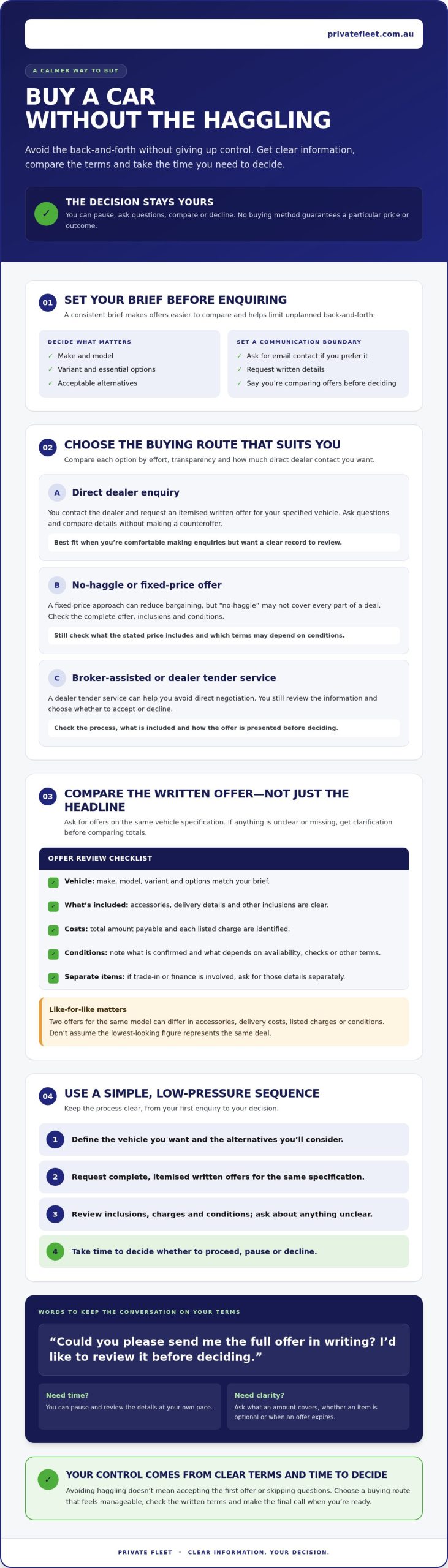
Asking questions isn’t the same as bargaining. You can ask what an amount covers, whether an item is optional or when an offer expires without making a counteroffer. If you need time, say, “Could you please send me the full offer in writing? I’d like to review it before deciding.” You can pause, seek clarification or decline. A written offer gives you a clearer basis for choosing, while the final decision remains yours.
How to avoid negotiating at a car dealership: prepare before you enquire
A little preparation helps keep enquiries focused and makes offers easier to assess. Use a simple sequence: define what you need, request comparable written offers, review the terms, then decide whether to proceed. You don’t need a perfect script. Clear requirements and communication preferences can limit unplanned back-and-forth.
Set your vehicle requirements and communication boundaries
Before contacting a dealer, separate must-haves from preferences. Note the make and model, variant, essential options and acceptable alternatives. For example, you might require a particular safety feature but be flexible about colour. This gives dealers a consistent brief and helps you compare like with like.
Choose how you want to communicate. If phone calls feel uncomfortable, ask for email contact and written details. You can also say, “I’m comparing written offers before making a decision.” That sets a polite boundary without turning the conversation into a negotiation. For more ideas on inviting competing offers, read this guidance on getting dealers competing for your business.
Ask for an offer you can assess without haggling
Request the complete offer in writing for the vehicle you specified. Ask the dealer to identify the variant, options, inclusions and relevant delivery details, along with the total amount payable and any listed charges. If trade-in or finance is part of your plans, ask for those details separately so you can see how each part affects the overall offer.
Check which details are confirmed and which depend on availability, further checks or other conditions. A written quote makes differences easier to spot, but it doesn’t mean every term is final. Ask for clarification where needed. Don’t assume two offers are comparable just because they describe the same model.
Online research can help you understand different buying routes. For example, online car-buying sites are compared in Forbes’ guide, but check whether an option suits Australian buyers and your requirements. The right process is one that gives you enough information and a comfortable level of contact.
Once you have the details, review them at your own pace. A new car buying service such as Private Fleet’s new car buying service may suit buyers who’d prefer support with the purchasing process rather than handling dealer enquiries themselves. Whichever route you choose, you decide whether an offer meets your needs.
Compare no-haggle, direct-dealer and broker-assisted buying options
There’s more than one way to avoid car dealership negotiation. You can contact dealers yourself, choose an advertised fixed-price offer or use a broker to manage dealer enquiries on your behalf. Each route involves a different balance of effort, contact and support. None is automatically cheaper or better, so compare the actual terms and choose the process that suits your preferences.
| Buying option | Buyer effort | Direct dealer contact | Offer transparency | Final decision control |
|---|---|---|---|---|
| Direct dealer enquiry | You research, contact dealers and compare replies. | Usually direct. | Depends on the detail provided; request full written terms. | You decide whether to accept, ask questions or decline. |
| No-haggle or fixed-price offer | Less focus on bargaining, but you still need to check the offer. | Usually direct, depending on the seller. | Check what the stated price includes and what conditions apply. | You decide whether the offer suits you. |
| Broker-assisted buying | A broker can handle parts of the dealer enquiry process. | May reduce the need for you to negotiate directly. | Review the offer and ask how the broker is paid. | You retain the choice to accept or decline an offer. |
What to check in a no-haggle or fixed-price offer
“No-haggle” describes an approach to the advertised vehicle price, not necessarily every part of the transaction. Check the exact make, model and variant, along with accessories, services, delivery details and any additional charges. Ask whether the written offer is current, subject to availability or conditional on further checks. A fixed price doesn’t remove the need to understand the full terms.
Compare equivalent vehicles and inclusions rather than relying on headline wording. A clearly advertised offer may make the price easier to review, but trade-in arrangements, finance and optional extras can still affect the overall deal. Ask for any relevant terms in writing before deciding.
How a dealer tender can reduce direct negotiation
A broker-assisted process can invite competing dealer offers based on your requirements, reducing the need to make separate enquiries and bargain directly. Private Fleet is an independent Australian car brokerage firm that uses a dealer tender network. It supports the buying process but doesn’t guarantee a particular price, saving or vehicle availability. You remain in control of whether to accept or decline an offer.
Before using any broker, check what support is included and how the broker is compensated. For more detail on this approach, see the guide to buying a new car without negotiating.
What to say when a dealer asks for a quick decision
A short, prepared response can help you stay courteous and keep the conversation focused. You don’t need to debate every point or decide on the spot. If you want to avoid car dealership negotiation, use simple phrases that bring the discussion back to the vehicle, the written terms and the time you need to consider them.
Simple phrases to keep the conversation on your terms
Choose wording that feels natural, then repeat it calmly if the conversation moves away from your requirements. For example:
- To request the full offer: “Could you please email me the complete offer, including the vehicle details, inclusions and any charges? I’ll review it before deciding.”
- To decline unrequested extras: “Thanks, but I’m only considering the vehicle and options I asked about. Please show me the offer without those extras.”
- To redirect a bargaining conversation: “I’m comparing the terms for this specific variant. Could we go through what’s included and what the total offer covers?”
- To ask for time: “I’m not ready to decide today. I’ll take the details away and get back to you if I’d like to proceed.”
Keep returning to your stated needs rather than feeling obliged to respond to every counteroffer or change of subject. A clear, repeated request is often more useful than explaining or defending your preference at length.
When an offer is incomplete or you feel rushed
If an offer doesn’t give you enough information to compare it, pause. Ask what remains unconfirmed and whether any terms depend on availability or further checks. This keeps the conversation practical without assuming bad intent. If the vehicle specification, inclusions or charges are still unclear, it’s reasonable to wait until you have the details in writing.
You can review the offer away from the dealership, where you have space to read it carefully and compare it with your requirements. If you decide it isn’t right, you can simply say, “Thank you, but I won’t be proceeding with this offer.” You don’t have to justify your decision or continue an enquiry that no longer suits you.
If you’d prefer support with dealer enquiries, you can explore Private Fleet’s new car buying service. An intermediary may reduce the need for direct bargaining, while the choice to accept or decline an offer remains yours.
Choose a lower-pressure way to buy your next new car
A calmer purchase starts with a straightforward decision path: clarify what you need, choose how you want to approach dealers, review the complete terms and decide in your own time. Direct enquiries may suit you if you’re comfortable contacting dealers and comparing responses. If you’d rather reduce calls, follow-ups or bargaining, an intermediary may make the process easier to manage.
Questions to ask before using a car-buying service
Before choosing a service, find out how it sources offers and which steps it handles for you. Ask whether you’ll communicate with dealers directly, how offers are presented and what you’ll need to organise yourself. Clarify any fees and what assistance is included before proceeding. If you’re considering trade-in assistance or finance support, ask how each fits into the process and what information you’ll receive to make your own decision.
These questions help you understand the service, not just its headline promise. A useful option should make the process clearer and suit the level of involvement you want. You shouldn’t have to accept an offer before reviewing the details.
How Private Fleet may help you avoid direct haggling
Private Fleet is an independent Australian car brokerage firm that supports private buyers nationally through a dealer tender network. The network invites competing dealer offers based on a buyer’s requirements, which can reduce the need to contact and negotiate with dealers individually. The buyer reviews the offer and chooses whether to accept or decline. This is support with the buying process, not a guarantee of a particular price, saving or vehicle availability.
Depending on your needs, assistance may also include vehicle sourcing, trade-in assistance or car finance. Ask what applies to your situation and review the relevant terms before making a decision. Finance information isn’t a substitute for personalised financial advice.
If you’d like a lower-contact way to explore a new car purchase, explore Private Fleet’s car-buying service. You can consider whether the approach fits your needs, then decide how you’d like to proceed.
Choose a car-buying process that feels right for you
You don’t have to haggle to stay in control of a new car purchase. Set out what you need, compare complete written offers on the same terms and take time to decide. Whether you contact dealers yourself or use an intermediary, check the details and choose the route that suits your confidence and preferences.
If you want to avoid car dealership negotiation, a broker-assisted option may reduce direct back-and-forth without taking away your choice. Private Fleet is an independent Australian car brokerage firm founded in 1999. Its national dealer tender network invites competing dealer offers, and its support can include vehicle sourcing and trade-in assistance. Offers and availability can vary, so review the terms and decide whether an option suits you.
Explore a lower-pressure way to buy your next car with Private Fleet and learn whether its buying service fits your needs. You can take the next step at your own pace, with the final decision in your hands.
Frequently Asked Questions
Can I buy a new car in Australia without negotiating with a dealer?
Yes, you can choose a buying process that avoids direct bargaining with a dealer. You might use a clearly advertised fixed-price offer or a car-buying service that manages dealer enquiries on your behalf. Either way, ask for the full offer in writing and review the vehicle details, inclusions and conditions. You decide whether to accept or decline, and avoiding negotiation doesn’t guarantee a particular price or outcome.
Is a no-haggle car price always the best offer?
No. “No-haggle” describes the approach to bargaining, not whether the offer is best for your needs. Check the exact vehicle variant, included accessories or services, delivery details, charges and any conditions. Also consider whether trade-in arrangements or finance affect the overall deal. Compare written offers for the same vehicle and terms rather than judging by the headline price or no-haggle label alone.
What should I say if a car dealer asks me to make an offer?
You can keep your response polite and ask to see the terms first. Try: “Could you please send me your complete written offer for this vehicle? I’ll review the details before deciding.” If you’d rather not name a figure, redirect the discussion to the vehicle specification, inclusions and total offer. You don’t have to make a counteroffer to ask questions, take time to consider the details or decline.
How can I compare new-car offers without negotiating?
Ask each seller for a written offer for the same make, model, variant and options. Check the listed inclusions, delivery details, charges and conditions, then clarify anything that’s missing. Keep trade-in and finance details separate where possible so you can see how they affect the overall proposal. Comparing equivalent terms lets you assess offers without making counteroffers or bargaining over each line.
Can a car broker negotiate with dealers on my behalf?
Yes. A car broker can manage dealer discussions and request competing offers on your behalf, which may reduce the need for direct negotiation. Private Fleet is an independent Australian car brokerage firm that uses a dealer tender network to invite competing dealer offers. Ask the provider how it’s paid and which steps it handles. You remain the decision-maker and can accept or decline an offer.
What happens if I do not accept a dealer’s offer straight away?
You can ask for the offer in writing and take time to review it before deciding. Check whether it’s current and whether it depends on vehicle availability or other conditions. If you need more information, ask what remains unconfirmed. You can then follow up, decline or leave the enquiry there. Don’t assume an offer will remain available indefinitely; confirm any time limits directly with the seller.
Can I avoid negotiating about my trade-in and car finance as well?
You can ask for trade-in and finance details to be provided separately in writing, then review them without agreeing to bargain. Request clear terms and ask questions about anything you don’t understand. A broker may offer trade-in assistance or car finance as part of its service, but check what support is included and consider finance choices carefully. This information isn’t personalised financial advice, and you can decide whether to proceed.