
What if the cheapest way to buy a new car isn’t to become a better negotiator, but to let dealers compete for your business? If you’re trying to save money buying new car australia, the sticker price, unclear on-road costs and pressure to visit dealership after dealership can make the process feel hard work before you’ve even chosen a car.
You can seek a sharper price without spending weeks haggling or wondering whether a fee has been added along the way. This guide explains how private buyers can pursue fleet-level pricing through a competitive dealer tender, where dealers bid for your business instead of you negotiating with each one individually.
You’ll also learn when discounts may be available, what to check in a drive-away quote and how to approach a trade-in so you can compare the whole deal, not just the headline price. Private Fleet helps Australians source new cars and provides trade-in assistance and finance. Here’s how to make the buying process clearer and compare your options with confidence.
Key Takeaways
- Look beyond the sticker price and assess the full offer, including dealer add-ons that may be presented as essential at the point of sale.
- Compare buying times such as EOFY and model run-outs, and check a vehicle’s build and compliance dates before deciding.
- A tender process shifts the focus from one-on-one haggling to competing dealer offers, helping you compare prices with less pressure.
- Separate government on-road charges from optional extras so you can see what’s required and what you can choose to decline.
- If you’re searching for “save money buying new car australia”, find out how private buyers can pursue fleet-level pricing and consider trade-in and finance as part of the overall deal.
The Traditional Dealership Model and Why It Costs You Money
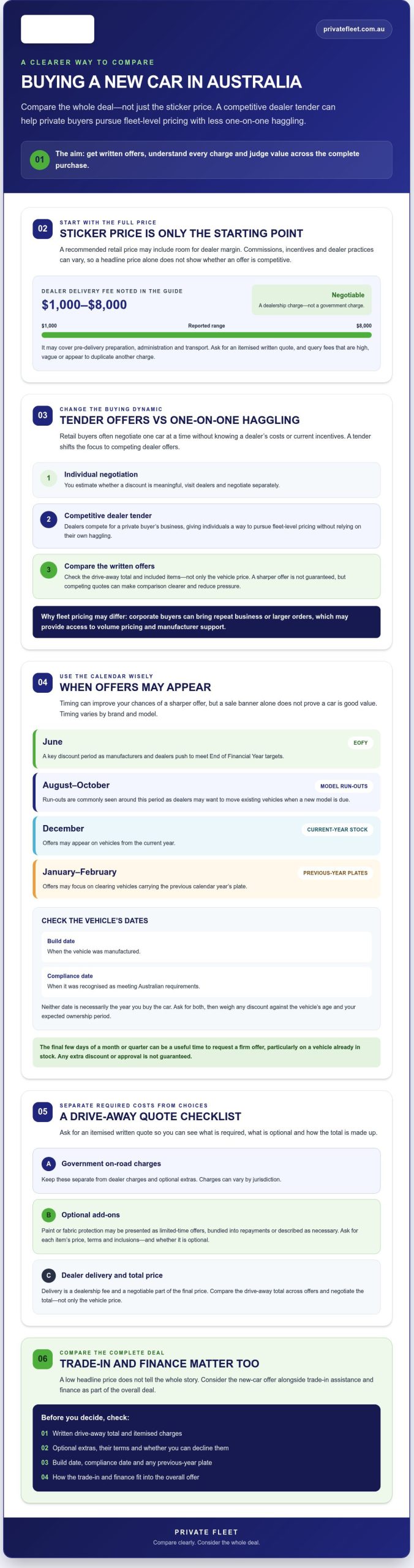
The sticker price is a starting point, not a transparent breakdown of what a dealer pays or earns. A manufacturer’s recommended retail price can include room for dealer margin, while commissions or incentives may also influence how a vehicle or add-on is presented. Practices vary between dealers, so the headline figure alone won’t tell you whether an offer is competitive.
Retail buyers often negotiate one car at a time without knowing a dealer’s costs or current incentives. Corporate fleet buyers can bring repeat business or larger orders, which may give them access to volume pricing and manufacturer support that an individual buyer can’t secure alone. The difference can be bargaining power, not the car itself.
At the point of sale, extras such as paint or fabric protection may be framed as limited-time offers, bundled into repayments or described as necessary to protect your new car. Ask for the price and terms of each item, what it includes, and whether it’s optional. You can also review an overview of the Australian Consumer Law to better understand consumer protections relevant to purchases and contracts.
The Hidden Margin in Dealer Delivery Fees
Dealer delivery fees are dealership charges for preparing and handling a vehicle for delivery. They’re a negotiable component of the final price. They may cover tasks such as pre-delivery preparation, administration and transport, but the fee isn’t a government charge. The research for this guide notes that dealer delivery can range from $1,000 to $8,000, depending on the deal and dealership.
Fees can vary because dealers may calculate or package these costs differently. Ask for an itemised written quote and compare the drive-away total across offers. If a fee is high, vaguely described or appears to duplicate another charge, ask the dealer to explain it. Negotiate the total rather than focusing only on the vehicle price.
Why Individual Negotiation Often Fails
The dealer knows the offer they’re prepared to accept; you’re usually estimating it from advertised prices and the conversation in front of you. That information gap can make it hard to judge whether a discount is meaningful. Visiting showroom after showroom can also wear you down, making a quick agreement feel easier than getting another quote.
A car broker Australia guide explains how a buying service can help bridge that gap. Private Fleet uses a competitive tender to have dealers compete for a private buyer’s business, giving individuals a way to pursue fleet-level pricing without relying on their own haggling. It’s a structured way to save money buying new car australia and avoid negotiating alone.
Strategic Timing: When to Maximise Your Savings in Australia
Timing can improve your chances of securing a sharper offer, but a sale banner alone doesn’t prove a car is good value. June is a key discount period as manufacturers and dealers push to meet End of Financial Year targets. December can bring offers on current-year stock, while discounts may also appear when a new model is due and dealers want to move existing vehicles. Model run-outs are commonly seen around August to October, although timing varies by brand and model.
The EOFY vs. New Year Plate Clearances
June promotions are often tied to financial-year targets; January and February offers may instead focus on clearing vehicles with the previous calendar year’s plate. A car’s build date is when it was manufactured, while its compliance date records when it was recognised as meeting Australian requirements. Neither date is necessarily the year you buy it.
A previous-year plate can affect how buyers perceive a vehicle’s age when you eventually sell or trade it, even if it’s otherwise the same model. Ask for both dates and weigh any discount against the car’s age and your expected ownership period. Before quarter-end, request written quotes on vehicles already in stock and compare the full drive-away price. For a practical guide to costs that can affect the total, see this breakdown of on-road costs. Charges can vary by jurisdiction.
End-of-Month Pressure Points
Some dealer and salesperson incentives may be linked to monthly or quarterly sales targets. The final few days of a reporting period can be a useful time to request a firm offer, particularly if the dealer has a vehicle in stock. A salesperson who is close to a target may have more reason to seek approval for a sharper price or reduce their commission, but there’s no guarantee. Treat the calendar as an opportunity to compare offers, not a reason to rush into a deal.
A new car buying service in Australia can approach competing dealers on your behalf, reducing the need to track every promotion or revisit multiple showrooms. Private Fleet’s competitive tender system helps private buyers pursue fleet-level pricing through dealer competition. If you’re weighing up how to save money buying new car australia, a service that manages the sourcing process can make price comparisons less stressful. You can explore Private Fleet’s new car buying service as one option.
The Dealer Tender System vs. Traditional Haggling
Traditional haggling puts you in a one-on-one negotiation: you ask a dealer for a price, try to judge whether it’s competitive, then repeat the process elsewhere. A dealer tender changes the structure. You provide a clear request, and participating dealers compete to win your business. You can then compare offers based on the same requirements, rather than relying on confidence or guessing when to walk away.
A tender doesn’t guarantee the lowest possible price. Check the strongest offer against the exact vehicle, delivery details and included costs. Competition can establish a useful price benchmark and reduce the pressure of negotiating across multiple showrooms. It may also bring forward offers on vehicles already in stock or becoming available, including options that may not be prominent in public advertising.
How the Tender Process Works
- Specify the vehicle. Set out the make, model, grade, colour, required options and accessories. Clear details help ensure dealers quote on a like-for-like basis.
- Send the request to dealers. A buying service can circulate your requirements through its participating dealer network.
- Compare the bids. Dealers submit offers to win your business. Review the full written terms, not just the headline price, and clarify any differences before deciding.
This approach works best when your request is precise. If one quote includes an accessory or a different specification that another doesn’t, the apparent saving may not be a fair comparison. For a detailed walkthrough of how this works from brief to final offer, see this guide to dealer tender car buying in Australia.
Why Dealers Participate in Tenders
Dealers may value a well-defined enquiry because it can lead to a straightforward sale without the usual showroom advertising and sales process. Some may also consider broader sales targets or volume incentives when deciding how competitively to bid. These factors vary by dealer and offer, so treat them as possible reasons a bid may be attractive to a dealer, not a promise of a particular discount.
Private Fleet uses a competitive tender system to help private buyers pursue fleet-level pricing without managing every negotiation themselves. For a closer look at the process, read this guide to how a car broker works. The central advantage is structural: rather than trying to persuade one salesperson to lower a price, you invite competing offers and assess them on clear terms. That can make it easier to save money buying new car australia while keeping the purchase process organised.
Minimising On-Road Costs: Rego, Stamp Duty, and Extras
A drive-away quote should show the total payable to get the car on the road, not just its advertised price. Depending on the vehicle and jurisdiction, that total can include the negotiated vehicle price, dealer delivery, stamp duty, registration, compulsory third-party insurance and, for some vehicles, Luxury Car Tax (LCT). Ask for an itemised quote so government charges, dealer charges and optional extras are easy to distinguish.
Registration and stamp duty rules vary across Australia. Stamp duty may be calculated using different bases, such as a vehicle’s value, weight or other state-specific criteria, so don’t assume the same calculation applies everywhere. Where duty is based on the vehicle’s value, negotiating a lower taxable price may also reduce the duty payable. Check the relevant state or territory rules and ask the dealer to explain how each charge has been calculated.
Check LCT and Compare Finance Offers
For 2026–27, the Luxury Car Tax threshold is $80,809 for vehicles that don’t meet the fuel-efficient vehicle criteria, and $91,661 for qualifying fuel-efficient vehicles with combined fuel consumption of 3.5 litres per 100 kilometres or less. The LCT rate is 33% on the value above the applicable threshold. If you’re considering a vehicle near either limit, confirm its classification and taxable value with the dealer, and check the current figures with the Australian Taxation Office before signing.
Don’t judge finance by the monthly repayment alone. Compare the interest rate, fees, loan term, any final balloon payment and the total amount repayable. Request the dealer-arranged offer in writing, then compare it with other finance options using the same assumptions. A lower repayment can simply reflect a longer term or a larger amount due at the end.
Handle Extras and Demonstrator Offers Carefully
In the after-sales office, a business manager may present protection packs or accessories such as window tinting, fabric protection and rustproofing alongside finance and other products. Ask for each item’s price and terms separately. If you’d rather source tinting or ceramic coating elsewhere, you can say, “Thanks, I’ll consider the vehicle without those extras.” Keep the discussion focused on the agreed vehicle price and get any revised offer in writing.
Demonstrator vehicles can be worth considering, but check their registration status, kilometres, build and compliance dates, and when the manufacturer’s warranty began. A demonstrator may have a lower purchase price, while an earlier warranty start or existing registration can affect its value to you. Compare its total cost and remaining warranty with a new, unregistered vehicle before deciding.
To save money buying new car australia, focus on the complete deal, not a low headline price that grows with charges or add-ons. Explore Private Fleet’s new car buying service for support comparing vehicle offers, finance and trade-in options.
Accessing Fleet Pricing as a Private Australian Buyer: save money buying new car australia
Fleet pricing is often associated with large businesses, government departments and organisations buying vehicles in volume. A private buyer purchasing a single car usually has less negotiating leverage and may not qualify for the same arrangements directly. That does not mean fleet-level pricing is out of reach. A buying service can put a private buyer’s request to competing dealers, using their bids to pursue a sharper offer without requiring the buyer to negotiate at every showroom.
Private Fleet is an Australian brokerage that uses a competitive tender system to put dealers in competition for a buyer’s business. Its service is available nationally, and the tender approach helps private individuals pursue pricing generally associated with fleet buying. The offer will depend on the vehicle, dealer and current conditions, so compare the written quote and included terms before deciding.
Leverage a Wider Dealer Network
Rather than approaching one dealership and relying on its initial offer, a tender can circulate your requirements to dealers in a broader network. Dealers may be motivated by the chance to secure a sale, and competing bids give you a clearer basis for comparison. You do not need to claim a business fleet or manage each conversation yourself to explore this route.
Start with a precise brief: the model and grade you want, preferred colour, essential options and whether you are open to available stock. Clear requirements make it easier to compare like-for-like offers and assess whether a different vehicle or delivery arrangement changes the value.
Bring the Whole Purchase Together
A competitive vehicle price is only one part of the decision. Consider your current car’s trade-in value and finance terms alongside the new-car quote. Private Fleet provides trade-in assistance and car finance as well as help sourcing new cars, so you can consider these parts of the purchase together. Ask for written details and check what is included before agreeing to anything.
Delivery details depend on the dealer and should be confirmed as part of the quote. Ask where the vehicle will be handed over, whether delivery is available for your circumstances, and what the dealer includes at handover. Do not assume you will need to travel or that a full tank is included; get those details confirmed in writing.
The process is straightforward: set your requirements, compare competing offers, review the full costs, then consider trade-in and finance options before you commit. If you want to save money buying new car australia, ask Private Fleet about its new car buying service and what an enquiry involves. It is a practical starting point if you would rather not handle every dealer negotiation yourself.
Make Your Next New-Car Purchase a Confident One
To save money buying new car australia, focus on the whole deal, not just the sticker price. Compare written offers, check on-road charges and optional extras, and consider how timing, trade-in value and finance affect the total. You don’t have to rely on high-pressure, one-to-one haggling: dealer competition can help you assess your options with greater clarity.
Private Fleet helps Australians buy new cars through a competitive dealer tender, with support for sourcing, trade-ins and finance. This gives private buyers a way to explore fleet-level pricing while keeping the key parts of the purchase in view.
Ready to take the next step? Ask Private Fleet about its new car buying service. Comparing offers through a clearer process can help you choose with confidence.
Frequently Asked Questions
How much money can a car broker actually save me in Australia?
A car broker may help you secure a lower price, but there’s no fixed saving that applies to every buyer. The result depends on the vehicle, stock availability, timing and dealer offers. Private Fleet uses a competitive tender to invite dealers to compete for your purchase, helping private buyers pursue fleet-level pricing. Compare the written quote with other offers, including fees and inclusions, to see the actual difference.
Is it better to buy a new car at the end of the month?
It can be worth requesting quotes near month-end, but a discount isn’t guaranteed. Some dealer or salesperson incentives may be linked to sales targets, which could make a dealer more willing to consider a competitive offer. Ask for a written drive-away price and compare it with other quotes. Don’t rush into a deal just because the calendar is turning; check the vehicle, fees and inclusions first.
Can I really get fleet pricing if I am only buying one car?
Yes, a private buyer can pursue fleet-level pricing without purchasing a fleet. A car buying service can use a competitive tender to invite dealer offers based on an individual buyer’s requirements. The price and availability depend on the vehicle and dealer response, so review the specific offer. Private Fleet uses this approach to help individuals access pricing generally associated with larger buyers.
What are the most common hidden fees when buying a new car?
Check for dealer delivery charges, optional protection products and accessories, and the cost of dealer-arranged finance. These aren’t all hidden or automatically avoidable: ask for an itemised quote to separate dealership charges and optional extras from government costs such as registration and stamp duty. Confirm what’s included in the drive-away figure, and ask whether each add-on is optional before agreeing to it.
Is the EOFY sale actually the cheapest time to buy a car?
EOFY can be a good time to compare offers because dealers and manufacturers may be working towards financial-year targets, but it isn’t always the cheapest time for every model. December, model run-outs and available stock can also create opportunities. If you’re researching “save money buying new car australia”, compare the total price, vehicle specification and delivery terms across different dates rather than relying on a sale label.
How does the trade-in process work with a car buying service?
A car buying service can assist with your trade-in as part of the new-car purchase. Share accurate details about your current vehicle, then review the trade-in offer alongside the new car’s written price. Compare the changeover amount, which is what you pay after the trade-in is taken into account, rather than judging either figure alone. Ask how the offer is calculated and check any conditions before accepting.
Should I get my finance through the car dealership?
Not automatically. Ask the dealer for the finance offer in writing, then compare it with other options using the same loan amount and term. Check the interest rate, fees, total amount repayable and any final balloon payment, not just the advertised repayment. A lower repayment may reflect a longer term or a larger final payment. Choose the option that suits your budget and overall costs.
What is the Luxury Car Tax threshold for 2026?
For the 2026–27 financial year, the Luxury Car Tax threshold is $80,809 for other vehicles and $91,661 for qualifying fuel-efficient vehicles. To qualify for the higher threshold, a vehicle must have combined fuel consumption of 3.5 litres per 100 kilometres or less. The LCT rate is 33% on the amount above the applicable threshold. Confirm the vehicle’s classification and current details with the Australian Taxation Office before purchase.