
The most expensive Mazda on your shortlist may not be the best fit for your everyday driving. If you’re buying a new Mazda in Australia, compare variants and ownership costs against your routine, from commuting and regional trips to carrying passengers or luggage. Mazda’s broad range can make it hard to know where to start, and an advertised price alone won’t show the full ownership picture.
It’s sensible to look beyond the badge and compare what each model and variant offers for your needs. This guide will help you build a practical shortlist, check equipment and pricing on a like-for-like basis, and consider costs such as servicing, fuel or electricity, insurance and resale. Mazda’s new-vehicle warranty is five years with unlimited kilometres, while service intervals for most passenger cars and SUVs are every 12 months or 10,000 kilometres, whichever comes first. Your exact model and driving pattern still matter.
We’ll walk through the range, explain the key variant and powertrain differences, and outline the assumptions that shape ownership costs, so you can make a considered comparison before requesting a quote.
Key Takeaways
- Start your shortlist with the job the car needs to do, then weigh space, comfort, visibility and ease of use against your everyday routine.
- When you buy a new Mazda Australia compare variants and ownership costs by checking which equipment matters to you and whether each offer uses the same price basis.
- Separate standard features from optional accessories and higher-variant equipment to avoid paying for items you don’t need.
- Build a more complete ownership estimate by accounting for resale uncertainty, energy, tyres, insurance, registration and any charging installation.
- Compare equivalent written offers, ordering details and trade-in terms; Private Fleet’s tender process invites multiple authorised dealerships to compete for your business.
Which new Mazda suits your needs? Start with the right buying criteria
Start by matching the car to its everyday role, then narrow your Mazda shortlist by comfort, space, equipment and ownership needs. There’s no single model or variant that suits every buyer. Your routine, parking situation and priorities behind the wheel should guide the choice. Browse the new car range, using your needs as the filter rather than choosing by badge or trim name alone.
A practical brief also makes it easier to compare variants and estimate ownership costs. Mazda Motor Corporation’s brand history and background provides useful context, but your shortlist should focus on how each vehicle fits your life.
What will the Mazda need to do each week?
Separate regular commuting from longer trips and occasional needs. A car used mostly for commuting may call for different space and comfort priorities from one that regularly carries passengers, luggage or bulky items. Downsizing, taking grandchildren along or travelling regionally are useful examples to consider, not assumptions about what you need.
Check the practical fit, too. Think about your usual parking space, sightlines when reversing and how easy the car feels to manoeuvre in familiar conditions. Note your typical weekly driving and approximate annual kilometres, plus how long you expect to keep the vehicle. These details help you compare options on a realistic basis.
Which comfort and usability details deserve a closer look?
Where practical, sit in and drive the variants on your shortlist. Check whether the seat adjusts to a comfortable position, whether getting in and out feels natural, and how the ride and cabin noise suit your regular routes. A higher seating position may appeal to some buyers, while others may prefer a different seating feel or vehicle size.
Try the controls you’ll use often, including climate settings and audio. Consider whether physical buttons, touchscreen menus or a mix of both feels intuitive to you. Then check the exact Australian variant specification for parking assistance and safety equipment; features can differ between grades, so don’t assume that a model name tells you what’s included.
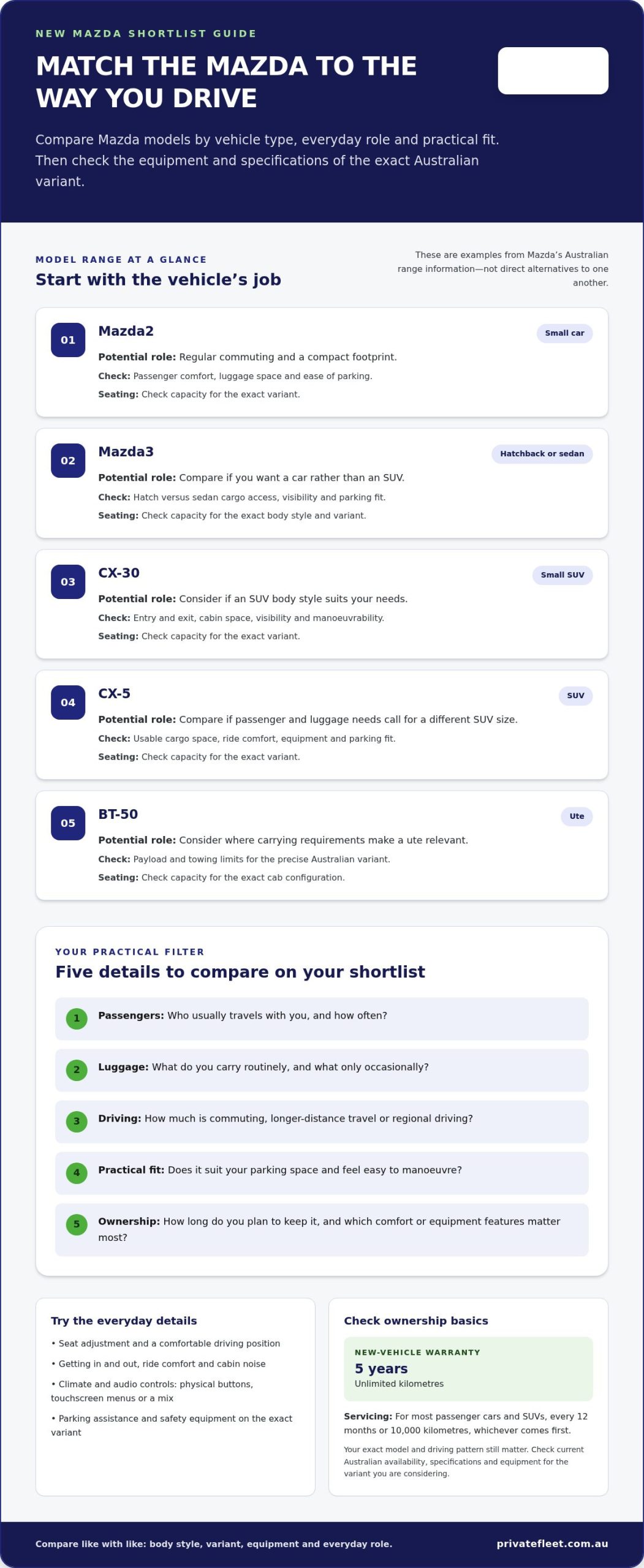
- Passengers: Who usually travels with you, and how often?
- Luggage: What do you carry routinely, and what only occasionally?
- Driving: How much is commuting, longer-distance travel or regional driving?
- Practical fit: Does the car suit your parking space and feel easy to manoeuvre?
- Ownership: How long do you plan to keep it, and which comfort or equipment features matter most?
Compare the new Mazda range by vehicle type, size and purpose
Group Mazda models by the job they need to do before comparing variants. A compact car, an SUV and a ute aren’t direct alternatives simply because they share a badge. Body shape affects passenger and cargo needs, parking fit and the driving position, so compare like with like where you can. The examples below are drawn from Mazda’s Australian range information; check current availability and exact details against Mazda Australia’s specifications before deciding.
| Model | Body style | Potential role | Seating | Key decision checks |
|---|---|---|---|---|
| Mazda2 | Small car | Consider for regular commuting and a compact footprint. | Check capacity for the exact variant. | Passenger comfort, luggage space and ease of parking. |
| Mazda3 | Hatchback or sedan | Compare if you want a car rather than an SUV. | Check capacity for the exact body style and variant. | Hatch versus sedan cargo access, visibility and parking fit. |
| CX-30 | Small SUV | Consider if an SUV body style suits your needs. | Check capacity for the exact variant. | Entry and exit, cabin space, visibility and manoeuvrability. |
| CX-5 | SUV | Compare if passenger and luggage needs call for a different size of SUV. | Check capacity for the exact variant. | Usable cargo space, ride comfort, equipment and parking fit. |
| BT-50 | Ute | Consider where carrying requirements make a ute relevant. | Check capacity for the exact cab configuration. | Payload and towing limits for the precise Australian variant. |
How do Mazda cars and SUVs differ for everyday use?
A car may suit your parking space and passenger routine, while an SUV’s shape or seating position may better match your preferences. Neither body style guarantees easier access, better visibility or a more comfortable ride. Assess those details for yourself, and compare current Australian dimensions, seating, safety features and equipment for the exact versions you’re considering. A focused shortlist helps you compare Mazda variants and ownership costs according to each vehicle’s role, rather than treating every model as a direct rival.
When should a ute or electrified Mazda enter the shortlist?
Put a ute on the list only if its cargo capability or towing role fits your regular needs. Before comparing, verify payload and towing limits for the precise model, variant and configuration; don’t assume figures carry across the range. For an electrified option, consider whether you can charge where you park and whether your regular driving pattern suits it. Keep the powertrain comparison focused on your use, then explore electric vehicle guides for more detail.
Once you’ve narrowed the choice by vehicle type, browse Mazda vehicle reviews for additional model context. If you’d like help shaping a shortlist, share your preferred Mazda, postcode and buying timeframe.
Which Mazda variant is worth comparing? Match equipment to real needs
A higher grade is worth considering only if its extra equipment matters to you. Compare the exact Australian specifications, then weigh useful features against the price difference. For each shortlisted model, separate what’s standard from optional accessories and equipment reserved for another variant or powertrain. That gives you a clearer basis to buy a new Mazda Australia compare variants and ownership costs without assuming the top grade is automatically the best value.
How can you judge whether a higher variant adds useful value?
Sort features into three groups: used often, used occasionally and unlikely to use. Seat adjustment, controls, safety equipment and parking assistance may affect everyday comfort and convenience, but check the precise variant specification rather than relying on a grade name. Also confirm whether a feature is standard, an optional accessory or available only with a particular powertrain.
For current equipment details, use Mazda Australia’s model and variant information. Record the date you check it, as specifications and offers can change. If you’re comparing vehicles in person, try the seat and controls, and consider whether the parking aids suit the places you regularly drive.
| Model and variant | Equipment to verify | Price basis | Offer date and buyer notes |
|---|---|---|---|
| Mazda2, exact variant | Check standard safety, parking aids, seat adjustment and controls in the current Australian specification. | Record the written drive-away quote and applicable location. | Record the date checked, offer expiry and features important to your routine. |
| Mazda3, exact variant | Separate standard equipment from accessories and higher-grade or powertrain-specific features. | Compare a like-for-like drive-away quote. | Note offer expiry and any equipment differences affecting your choice. |
| CX-30 or CX-5, exact variant | Verify safety, parking assistance, seat adjustment and controls for each variant. | Use the same price basis and location for both quotes. | Record the date checked and assess each feature against your needs. |
How do you compare drive-away offers fairly?
Put equivalent vehicles side by side: same model, variant and relevant equipment, with each quote clearly stating its price basis and applicable location. Record when each offer was checked and its expiry. Don’t treat an older advertised figure as a current offer; verify it against current Mazda or authorised-dealer information. This makes the comparison clearer before you decide which variant to pursue.
What does Mazda ownership cost? Compare the full picture, not one figure
Total ownership cost is an estimate of what you spend to buy and run a vehicle over a chosen period, less what you might receive when you sell it. It depends on how long you keep the Mazda, how far you drive and your personal costs. To buy a new Mazda Australia compare variants and ownership costs on the same assumptions, rather than relying on the drive-away price or a single fuel-consumption figure.
Which costs should a Mazda buyer compare?
Start with the quoted drive-away price, then estimate resale value and the costs of using and maintaining the vehicle. Include:
- Purchase and resale: Use the same ownership period for each option, and treat future resale as uncertain.
- Energy: Estimate fuel or electricity use from your kilometres and applicable energy prices.
- Servicing and tyres: Use the current Mazda servicing schedule for the exact model and variant, and account for tyre replacement during your ownership period.
- Insurance and registration: Obtain estimates relevant to your circumstances and location.
- Charging: If considering a plug-in vehicle, include installation costs where relevant, as well as home and public charging.
- Finance: If you’re borrowing, include interest and fees. Don’t add the loan principal again if the vehicle’s purchase price is already counted.
Check current warranty terms in Mazda’s Australian warranty information for the precise vehicle. For fuel or electricity, compare like with like: published test figures are not a promise of real-world use. Apply a consistent method to each shortlisted variant and make your assumptions visible.
How should ownership-cost estimates handle uncertainty?
Write down the assumptions beside every estimate: ownership duration, annual kilometres, energy prices and expected consumption. For an electrified Mazda, also state the share of charging at home versus public chargers, any charging losses and, for a plug-in hybrid (PHEV), the estimated share of distance driven on electric power. A PHEV’s charge-weighted fuel figure combines different driving conditions, so don’t compare it directly with a conventional hybrid’s figure.
Resale is uncertain, so test three scenarios: low, base and high estimated resale values. Recalculate the ownership estimate for each; none is a guarantee. This makes it easier to see how much your conclusion depends on what the vehicle might be worth later.
For a more personal comparison, bring your preferred Mazda variants, postcode and buying timeframe together with your annual kilometres and charging access.
How to buy your new Mazda: compare offers and move ahead confidently
Once you’ve narrowed your shortlist, make the next step a like-for-like comparison. If you plan to buy a new Mazda in Australia, compare variants and ownership costs alongside written offers, trade-in terms and ordering details. A clear record helps you see what each offer includes and decide which option fits your needs.
What should you have ready before requesting Mazda offers?
Prepare your preferred model and variant, budget, postcode and buying timeframe. If you have a trade-in or want to explore finance, include that in your brief if it’s relevant. Then record each offer consistently:
- Vehicle: model, variant, powertrain and any requested accessories.
- Price: whether it’s drive-away, the applicable location and what’s included.
- Timing: date received and offer expiry, plus any stated ordering details.
- Trade-in: keep the trade-in figure and conditions distinct from the new-car price.
Check that the vehicles being compared have equivalent specifications and equipment. If an offer differs, note the difference rather than treating the figures as directly interchangeable.
How can an independent buying service simplify the process?
Private Fleet is an independent Australian vehicle sourcing and car buying service. It works with a national network of authorised dealerships and uses a tender process that invites multiple dealers to compete for your business. This provides a way to compare dealer offers through one buying process, without promising a lowest price or guaranteed saving.
Private Fleet can also assist with trade-ins as part of your new-car purchase. You remain in control of the model and variant you choose, while the sourcing process helps bring offers together for comparison. Read about the new-car buying service and see how the new-car buying process works.
Ready to take the next step? Share your preferred Mazda model, postcode, shortlist and buying timeframe to get help with your new-car purchase.
Make your Mazda shortlist work for you
Choose a Mazda by matching its role, comfort and equipment to your everyday needs, then compare written offers on the same basis. A fuller ownership estimate should also account for running costs and uncertain resale, not just the initial price. This is a practical way to buy a new Mazda Australia compare variants and ownership costs before you request a quote.
Private Fleet is an independent Australian car brokerage firm founded in 1999. Its tender process invites multiple authorised dealerships to compete for your business, giving you a way to compare offers alongside your shortlist and buying priorities. There’s no need to settle for a variant simply because it has a higher grade name; focus on the features and ownership picture that suit you.
Bring your preferred Mazda model and variant, postcode, shortlist and buying timeframe to take the next step. A considered comparison can help you move ahead with greater clarity and confidence.
Get help buying my new car
Your next Mazda decision can start with a clear brief and a comparison shaped around you.
Frequently Asked Questions
Which Mazda model is best for everyday driving in Australia?
There’s no single Mazda that’s best for every driver. Start with your usual passengers and luggage, typical kilometres, parking situation and preferred body style, then shortlist models that fit those needs. Compare current Australian specifications for the exact models and variants. Consider visibility, seat comfort, ride quality and how intuitive the controls feel, as well as space. A focused shortlist makes comparing equipment and offers more useful.
How do I compare Mazda variants fairly?
Compare the same model and powertrain, then check each variant’s standard equipment, optional extras and drive-away price basis. Focus on features you’ll use, such as safety equipment, parking assistance, seat adjustment or cabin technology. Confirm current Australian specifications and each offer’s expiry before deciding. A higher grade isn’t automatically better value; it’s worth considering when its additional equipment suits your needs and budget. Record differences so you can compare the offers accurately.
What costs should I include when buying a new Mazda?
Include the purchase price, estimated resale value, fuel or electricity, scheduled servicing, tyres, insurance and registration. If you’re considering a plug-in vehicle, account for charging installation where relevant. For finance, include interest and applicable fees, but don’t count the loan principal twice if you’ve already included the vehicle’s purchase price. Compare estimates across the same ownership period and annual kilometres, and treat resale as uncertain. State the assumptions behind low, base and high resale estimates.
Are Mazda drive-away prices the same across Australia?
Don’t assume every advertised drive-away figure applies to every buyer. The amount can depend on the exact model, variant, offer conditions and applicable location. Check what the quote covers, when the offer expires and whether it matches your chosen specification. Use current Australian manufacturer or authorised-dealer information, then compare like with like. Archived prices may no longer apply, so verify an advertised offer is current before using it to assess your options.
Can I compare a Mazda hybrid or electric model with a petrol Mazda using fuel-consumption figures?
Not directly in every case. A battery electric vehicle (BEV) uses electricity, while a plug-in hybrid (PHEV) can use electricity and fuel. A conventional hybrid combines an engine with electric assistance, but isn’t another name for a PHEV. Consider charging access, driving patterns and energy-price assumptions. Keep laboratory test figures separate from real-world estimates, especially for a PHEV, whose fuel use depends partly on how often it’s charged and driven electrically.
Is Mazda warranty coverage the same for every model and variant?
Check the current Mazda Australia warranty booklet for the exact vehicle rather than assuming every term is identical. Review the coverage period, exclusions, service conditions and transferability. For an electrified model, distinguish the vehicle warranty from any separate battery warranty or capacity guarantee, including its own conditions. Manufacturer terms can change, so note which document you consulted and when. Use the applicable Australian information, not warranty advice intended for another market.
How can Private Fleet help me buy a new Mazda?
Private Fleet is an independent Australian car buying service that sources new vehicles through a national network of authorised dealerships. Its tender process invites multiple dealers to compete for your business, providing a way to compare offers without a promise of a lowest price or guaranteed saving. Trade-in assistance is also available as part of the buying process. Share your preferred Mazda, postcode, shortlist and buying timeframe to discuss your purchase.