
Could a lower repayment leave you paying more overall? It can, so comparing new car finance options Australia-wide starts with the total commitment, not the headline figure. The right choice depends on your budget, how long you plan to keep the car and whether you want to own it outright.
It’s easy to focus on the repayment and miss the fees, end-of-term obligations or how finance fits with the drive-away price and your trade-in. A secured or unsecured personal loan, dealer finance and, for eligible employees, a novated lease work differently. Compare them using the same vehicle price and assumptions.
This guide explains the main options and what to check before committing, including total repayments, fees, flexibility and any final lump sum. It also shows how finance can sit alongside comparing new-car offers and trade-in assistance, helping you assess the purchase as a whole.
Key Takeaways
- Compare new car finance options australia buyers may consider by ownership, payment structure and flexibility, not just the repayment amount.
- Check the total payable, fees, loan term and any final payment to understand the full commitment.
- Make comparisons fair by using the same vehicle price, deposit and repayment assumptions for each option.
- Set a comfortable overall budget, then shortlist the make, model and variant and review the drive-away offer before arranging finance.
- See how Private Fleet’s dealer tender process and trade-in assistance can fit alongside sourcing a new car and considering finance.
New car finance options in Australia: start with the whole purchase
Compare funding choices by the full amount you’ll commit, the flexibility you need and how long you plan to keep the car. A repayment can look manageable on its own while leaving out fees, a final payment or the effect of your deposit. Start with the complete new-car offer, including the drive-away price and any trade-in, rather than a finance figure in isolation.
Finance can mean borrowing money to buy a vehicle or using a lease arrangement. With a loan, you borrow and repay under agreed terms. With a lease, payments relate to using the vehicle, and the agreement sets out what happens at the end. These structures aren’t interchangeable, so the specific terms matter. Car finance on Wikipedia gives a general overview of common arrangements. This section focuses on private new-car purchases, not business fleet finance. A broader new-car buying service can help put the vehicle offer and finance decision in context.
What should a new-car finance decision include?
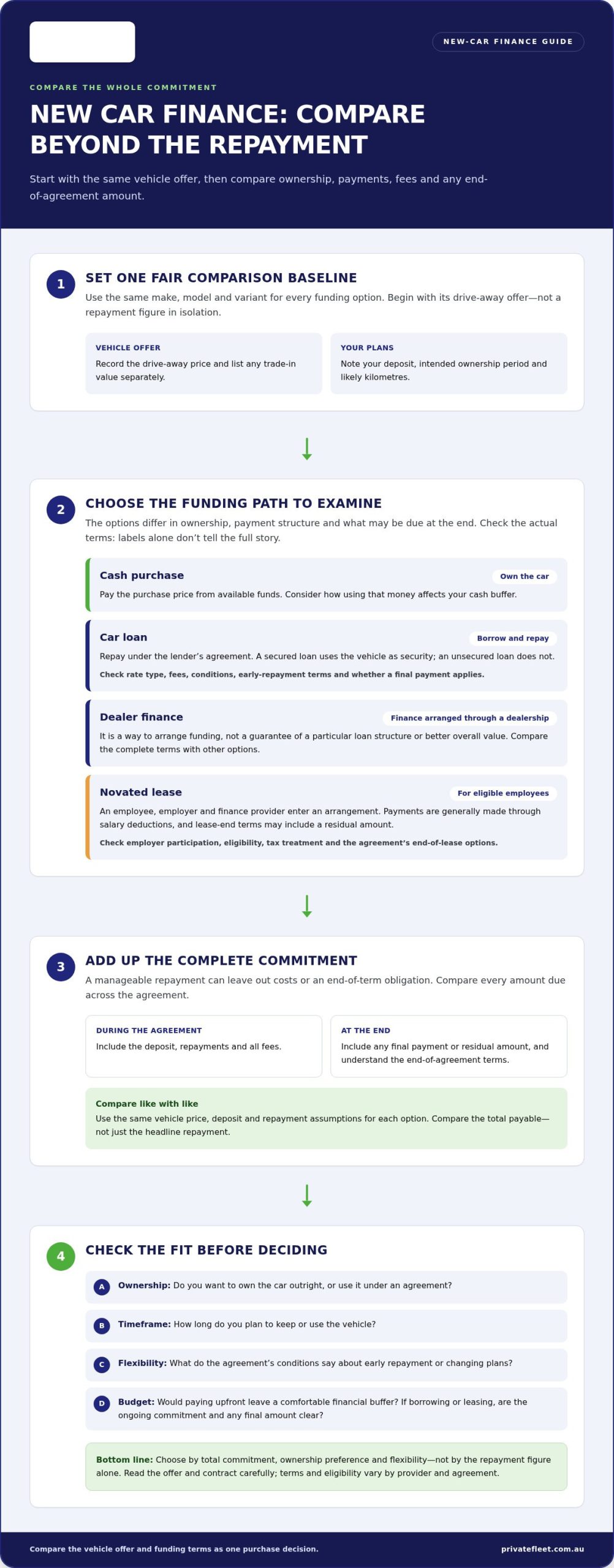
Compare the same vehicle, make, model and variant across each option. Use its drive-away offer, then account for your deposit, repayments, fees and any final payment. Your intended ownership period, likely kilometres and plans to keep, sell or change the car can affect which structure feels practical. New car finance options in Australia cover different arrangements, so compare their terms rather than relying on labels alone.
- Record the vehicle price and any trade-in value separately.
- Include every payment due during the agreement and any amount due at the end.
- Note how long you expect to own or use the vehicle and how much you’re likely to drive.
When might finance suit your buying plans?
Spreading payments may suit buyers who prefer to manage the purchase over time rather than pay the full amount upfront. It can also help preserve cash for other priorities, though borrowing adds costs and creates an ongoing commitment. Paying from available funds may suit someone who values avoiding repayments, provided the purchase still leaves a comfortable financial buffer.
There’s no single right choice based on age, income or lifestyle. A buyer planning to keep a car for many years may weigh ownership and total borrowing cost differently from someone expecting to change vehicles sooner. Consider your budget, likely kilometres and comfort with a future lump sum before choosing.
If you use a worked comparison, label it hypothetical and state its assumptions, such as the vehicle price, deposit, term and payment frequency. That keeps the comparison useful without presenting an illustrative repayment as a quote. Once the vehicle offer and your ownership plans are clear, assess the finance structure against the purchase you intend to make.
Compare new car finance options: loans, dealer finance and leasing
For a private new-car buyer, the main choices include paying with available funds, borrowing through a lender, arranging finance through a dealer or using a novated lease if eligible. They differ in who owns the vehicle, how payments work and what may be due at the end. Treat finance as one part of the purchase: compare the make, model, variant and drive-away offer, then assess how each funding arrangement fits.
| Option | Ownership and payments | Flexibility and questions to resolve |
|---|---|---|
| Cash purchase | You pay the purchase price from available funds and own the car. | There are no loan repayments, but consider how using the funds affects your cash buffer. |
| Car loan | You borrow from a lender and make repayments under the loan agreement. A secured loan uses the vehicle as security; an unsecured loan does not. | Check the rate type, fees, conditions, early-repayment terms and whether a final payment applies. |
| Dealer finance | Finance is arranged through the dealership, often as a loan with payments set by its agreement with the lender. | Compare the complete finance terms with other funding choices, not just the repayment shown with the vehicle offer. |
| Novated lease | An employee, employer and finance provider enter an arrangement, with payments generally made through salary deductions. Lease-end terms may include a residual amount. | Check employer participation, eligibility, tax treatment and the end-of-lease options that apply to the agreement. |
Availability, terms and eligibility vary by provider and agreement. The Australian Government’s Moneysmart guide to Car Loans explains key loan considerations for Australian borrowers. Read the relevant offer and contract carefully before deciding.
How do car loans and dealer finance differ?
A secured loan uses the car as security for the borrowing; an unsecured loan doesn’t tie the loan to the vehicle in the same way. A fixed interest rate generally stays the same for the agreed period, while a variable rate can change under the loan terms. Neither structure suits everyone. Compare the interest rate and total amount payable, plus fees, conditions and any early-repayment charge or final payment. Dealer finance is a way to arrange funding, not a guarantee of a particular loan structure or better overall value.
When could a lease or cash purchase be relevant?
A novated lease isn’t another name for a car loan. It involves an employer as well as the employee and finance provider, and its tax treatment depends on current rules and individual circumstances. Paying cash may suit a buyer who prefers to own the car outright and can do so without weakening their financial buffer. Borrowing or leasing may better match someone who values keeping more funds accessible, while accepting ongoing payments and agreement conditions.
Compare options against the same vehicle and drive-away offer so a change in finance doesn’t obscure a difference in the car or its price. If you’re weighing finance alongside a new-car shortlist, share your preferred make or model, postcode and buying timeframe to discuss your purchase.
How to compare car finance beyond the monthly repayment
The lowest repayment does not necessarily mean the lowest total commitment. A longer term or a large final payment can make regular instalments look smaller while changing the total you pay. Compare the vehicle offer and finance costs separately, then bring them together to understand the full purchase.
Use the same new-car make, model, variant and drive-away price for each quote. Keep the deposit, trade-in assumptions, repayment frequency and loan term consistent too. Otherwise, you may be comparing different vehicles or different amounts borrowed rather than the finance itself. For buyers comparing new car finance options Australia-wide, a like-for-like comparison helps make the differences clearer.
Which finance terms deserve a closer look?
Check the comparison rate as well as the advertised interest rate. In Australia, it is designed to reflect the interest rate and most standard fees, but it uses set assumptions and may not include every cost or precisely reflect your agreement. Read the assumptions and the lender’s fee schedule. A lower comparison rate can be a useful clue, not a substitute for checking the contract.
A balloon payment is a larger amount scheduled for the end of some loans; a lease may also specify a residual amount due or otherwise addressed at the end. Either can reduce the regular repayments while leaving a substantial obligation later. Check the amount, due date and what you must do to settle or otherwise meet that obligation. Also read the conditions for early repayment, including any charges or limits.
- Total payable: Add the deposit, all scheduled repayments, fees and any final payment.
- Rate and term: Record whether the rate is fixed or variable, how long the agreement runs and whether repayments could change.
- Fees and conditions: Identify establishment and ongoing charges, optional products, early-repayment terms and other conditions.
- Deposit and final payment: Note how much you pay upfront and whether a balloon or residual is due at the end.
How do trade-ins and purchase offers affect the comparison?
Keep the vehicle’s drive-away price distinct from borrowing costs and optional add-ons. A finance quote may bundle products or present payments around a particular offer, so identify what the vehicle costs before finance charges and what each optional item adds. Compare written offers for the same variant and purchase assumptions, rather than treating a repayment estimate as the car’s price.
Show a trade-in as its own figure. For example, in a hypothetical purchase, a trade-in value contributes towards the purchase but is not the same as a cash deposit. State the trade-in value and cash contribution separately, then show how they affect the amount financed. This makes it easier to see whether a different repayment comes from the finance terms, a different vehicle offer or a changed contribution. The new-car trade-in guide can help you compare that part of the offer clearly.
A practical checklist before arranging new car finance
A clear sequence helps keep the vehicle decision in front and makes finance easier to assess. Set your budget first, then compare a specific car and drive-away offer against suitable funding terms. Treat preparation as two stages: organise your purchase information, then follow the application process set by the lender or finance provider.
What information can help you prepare?
Before approaching a lender, outline what you can comfortably contribute and repay, and collect the details of the vehicle you’re considering. This gives you a clearer basis for discussing the amount to borrow without assuming a lender will assess every application the same way. Each provider sets its own application process, assessment criteria and information requirements, so there’s no universal document list or guaranteed approval.
- Set your overall budget. Decide what the full purchase can reasonably cost, including your available deposit, potential trade-in contribution and ongoing repayments. Leave room for other regular expenses rather than setting a limit based only on a repayment estimate.
- Choose a vehicle to price. Shortlist the make, model and variant that suit your needs. Confirm current specifications and pricing through Australian manufacturer or authorised dealer sources, and note whether the offer is drive-away and what it includes.
- Record your purchase assumptions. Write down the drive-away amount, deposit, trade-in estimate, intended loan term and repayment frequency. Keep these consistent when comparing finance so any difference is easier to identify.
- Review the agreement, not just the estimate. Note the interest rate, fees, conditions, early-repayment terms and any final payment. Get any unfamiliar term explained before proceeding.
- Follow the provider’s application steps. Once you have chosen a finance option to explore, use that lender’s instructions for applying and supplying information. Preparation helps, but the lender determines what it needs and how it assesses the application.
How should finance fit the car-buying timeline?
Compare funding before you commit to a vehicle contract, and understand any finance conditions that could affect your purchase. Keep your preferred model, buying timeframe and trade-in plans in view. If a trade-in is part of the offer, make sure its value and the vehicle price are recorded separately so you can see how each affects the amount to fund.
Vehicle sourcing can happen alongside this preparation. Private Fleet’s end-to-end car buying service works with a national network of authorised dealerships, inviting multiple dealers to compete for a buyer’s business through a tender process. This can help keep the vehicle shortlist and offer central to the decision while you consider finance. The best new car finance options Australia buyers can choose from still depend on their individual budget, preferred vehicle and the terms available to them.
Before signing, read the vehicle and finance documents together. Check that the agreed model and variant, drive-away offer, trade-in assumptions and funding terms match what you intend to buy. If anything differs, resolve it before proceeding.
How Private Fleet can help with a new-car purchase and finance
Finance is easier to assess when it’s connected to the vehicle you intend to buy. Private Fleet’s new-car buying service can help you consider the car, purchase offer, trade-in and finance as parts of one decision, so you can keep your priorities in view rather than focus on a repayment figure alone.
Start with a preferred make or model, or share a shortlist if you’re still deciding. Private Fleet’s tender process invites multiple dealers in its national network to compete for your business. Trade-in assistance and car finance can also support the wider purchase. The right arrangement depends on your circumstances and the terms available to you, so review the vehicle and finance details before committing.
What does support look like across the purchase?
Vehicle selection and finance can be considered together as your purchase takes shape. The car-buying process outlines the steps involved. Private Fleet sources vehicles through dealerships rather than holding its own vehicle inventory, while trade-in assistance and finance can help you consider the wider purchase. Check that the agreed vehicle, offer and finance terms match your decision before proceeding.
This can be useful if you’re weighing up different variants, have a trade-in to include or want to understand how funding fits your purchase plans. Keep each figure clear: the vehicle offer, trade-in value and finance costs are distinct parts of the decision.
What should you share to get useful buying help?
Share the details you already know and where you’d like help comparing choices. A shortlist can be useful even if you haven’t settled on one model. Include your buying timeframe so the discussion can reflect where you are in the decision process.
- Your preferred make or model, or a shortlist of vehicles.
- Your postcode and intended buying timeframe.
- Your budget and, if useful, a comfortable repayment range.
- Your approximate annual kilometres and expected ownership period.
- Trade-in details, if you plan to include your current vehicle.
These details help frame the next steps around your vehicle choice and buying plans, while leaving room to compare options before you decide.
Make your next car decision with confidence
Turn your preferences into a clear buying brief. Decide what matters most in your next vehicle and what level of ongoing commitment feels comfortable. This gives you a practical reference point as you move from researching to choosing, without letting a finance estimate dictate which car you buy.
Use what you’ve learned about new car finance options Australia buyers can consider to guide your decision. Review the vehicle offer and finance terms together, and make sure the arrangement still feels right before you proceed.
A considered purchase doesn’t need to be rushed. With your priorities clear, you can move forward at a pace that suits you and choose a new car with greater confidence.
Frequently Asked Questions
Can I get finance before choosing a new car?
Yes, some lenders may offer pre-approval before you select a vehicle, while others assess your application against a specific car. Pre-approval isn’t a guarantee of final approval and may have conditions or a validity period. Check how long it lasts and whether changing the vehicle affects the assessment. Before accepting finance, compare the final offer with the purchase contract and make sure the vehicle details match.
How much deposit do I need for a new car loan?
Deposit requirements vary by lender and finance product, so there’s no universal amount. Before deciding what to contribute, consider how much cash you want to keep available for other needs. Then review how the proposed deposit affects the lender’s offer and whether its terms include conditions about the amount or source of your contribution. Use the lender’s current information for your circumstances rather than relying on a general rule.
What happens if my car loan has a balloon payment?
A balloon payment is a larger amount due at the end of some loan agreements. Before signing, check the exact amount, due date and payment method set out in the contract. Consider how you would meet it alongside your other financial commitments at that time, and plan ahead rather than relying on an assumed future option. Read the agreement’s end-of-term terms carefully so you know what action is required.
Is dealer finance always cheaper than a bank car loan?
No. There’s no universal answer because finance offers can differ in rates, fees, conditions and eligibility. Compare written terms using the same vehicle, deposit, loan term and repayment frequency. Check whether an advertised offer applies to your chosen model and variant, and note its expiry or other conditions. The advertised repayment alone doesn’t establish which offer has the lower overall cost.
Can I pay off a car loan early in Australia?
That depends on the agreement and lender. Before making an extra payment or closing the loan, read the contract and request a current payout figure, which shows the amount required to settle at that point. Check whether the lender applies early-repayment conditions or charges and how it handles additional repayments. For general Australian consumer information about car loans, consult the Moneysmart guide to car loans.
Does a novated lease suit every new-car buyer?
No. A novated lease depends on factors such as your employment arrangement, eligibility, vehicle choice and personal circumstances. Its tax treatment can change, so check current information from the Australian Taxation Office and consider independent tax advice. To assess whether it fits your plans, compare its full terms with a loan or cash purchase for the same vehicle, taking account of how long you expect to use it.
Can I include my trade-in when comparing new car finance?
Yes, but treat the trade-in valuation as a separate part of the purchase rather than assuming an initial estimate is final. The value may depend on the vehicle’s condition and the assessment made closer to the transaction. Make sure the agreed amount is recorded clearly in the purchase paperwork, then use that figure when reviewing the amount you’ll fund. This helps you spot changes between an early estimate and the final offer.
Ready to compare a new-car purchase and finance options? Get help buying my new car. Share your preferred make or model, postcode and buying timeframe to get started.