
A low Volvo quote can still lead to a more expensive ownership decision. If you’re considering a new Volvo in Australia, compare quotes on a like-for-like basis so the vehicle, variant and drive-away inclusions line up before you weigh the longer-term costs.
It’s understandable to focus first on the price. But your choice of model and powertrain, annual kilometres, servicing, energy use, insurance and eventual resale can all shape what ownership looks like. This guide helps you build a shortlist from Volvo’s current Australian range, compare written offers consistently and estimate costs without treating future resale values as guaranteed.
You’ll also find practical points to consider when choosing between electric, plug-in hybrid and mild-hybrid options, including how your driving and charging access may affect the fit. Private Fleet is an independent car buying service that invites offers from its national network of authorised dealerships through a tender process, helping you compare without managing every enquiry yourself.
Key Takeaways
- Shortlist current Australian Volvo models by your driving needs, preferred powertrain and ownership priorities, rather than the badge alone.
- To buy a new Volvo Australia compare ownership costs and new car quotes by matching the model, variant, powertrain and drive-away inclusions.
- Estimate ownership over a set period and annual distance, allowing for energy, servicing, tyres, insurance, registration and uncertain resale value.
- Read warranty terms alongside servicing requirements, and distinguish vehicle cover from high-voltage battery cover and capacity guarantees.
- Compare written offers and any trade-in separately, then choose the purchase approach that suits your shortlist and timeframe.
Which New Volvo in Australia Fits Your Needs and Driving?
Choose a Volvo by how you’ll use it, which variant suits you and what matters over the time you expect to own it, not by the badge alone. A compact SUV may be easier to park, while a larger vehicle can better suit regular passenger or luggage needs. Your usual routes and charging access can also affect which powertrain is practical.
Use Volvo Cars Australia’s model information as your reference for current local models and specifications. The Australian lineup information checked for this guide includes the EX30, EX40, XC60 and EX90 SUVs, the ES90 sedan and wagons. Names and variants can change, so confirm the specific vehicle remains available in Australia when you prepare a shortlist. For general background on the marque, see Volvo (company); it isn’t a source for current Australian specifications.
How should you shortlist Volvo models and variants?
Start with the journeys you make most often. Consider how many people travel with you, the size and shape of the luggage you carry, and whether the vehicle needs to fit your usual parking space. If you’re downsizing, check that the smaller body style still meets your everyday needs; if you regularly travel with family, assess rear-seat room and access in person.
Then compare the exact Australian variants. Equipment can differ across a model range, so don’t assume a feature shown in a review or advertised for one grade is included in another. Check the manufacturer’s specification for the variant you’re considering, including driver assistance and parking features. A short test drive can help you assess seat adjustment, ease of entry and exit, outward visibility, ride comfort, cabin noise and whether the controls feel intuitive to you. These are personal preferences, not assumptions to make based on age.
Use reviews as a starting point, not a substitute for checking the current local specification. New-car reviews can help you identify questions to explore during your own comparison.
Which powertrain suits your driving pattern?
A battery electric vehicle (BEV) runs on electricity and needs charging. A plug-in hybrid (PHEV) combines a rechargeable battery and electric motor with a petrol engine; it can be charged externally, and how often you can charge affects how much of your driving can be electric. A mild hybrid uses a small electric system to assist a petrol engine, but it isn’t a plug-in vehicle. It’s also different from a conventional hybrid, which uses a battery that isn’t plugged in for external charging.
Think about access to home charging, annual kilometres, regular trip lengths and how often you take longer journeys. A BEV may suit drivers with convenient charging and routes that fit their charging routine. A PHEV’s fit depends partly on whether you’ll charge it regularly. A mild hybrid may appeal if you prefer a petrol vehicle without plugging in. The right choice also depends on how long you plan to keep the car.
Before comparing versions, check Volvo Cars Australia’s model and powertrain specifications, recording the date you checked them. A realistic shortlist of models, variants and powertrains gives you a sound basis for comparing their suitability and purchase offers.
How to Compare New Volvo Quotes on Equal Terms
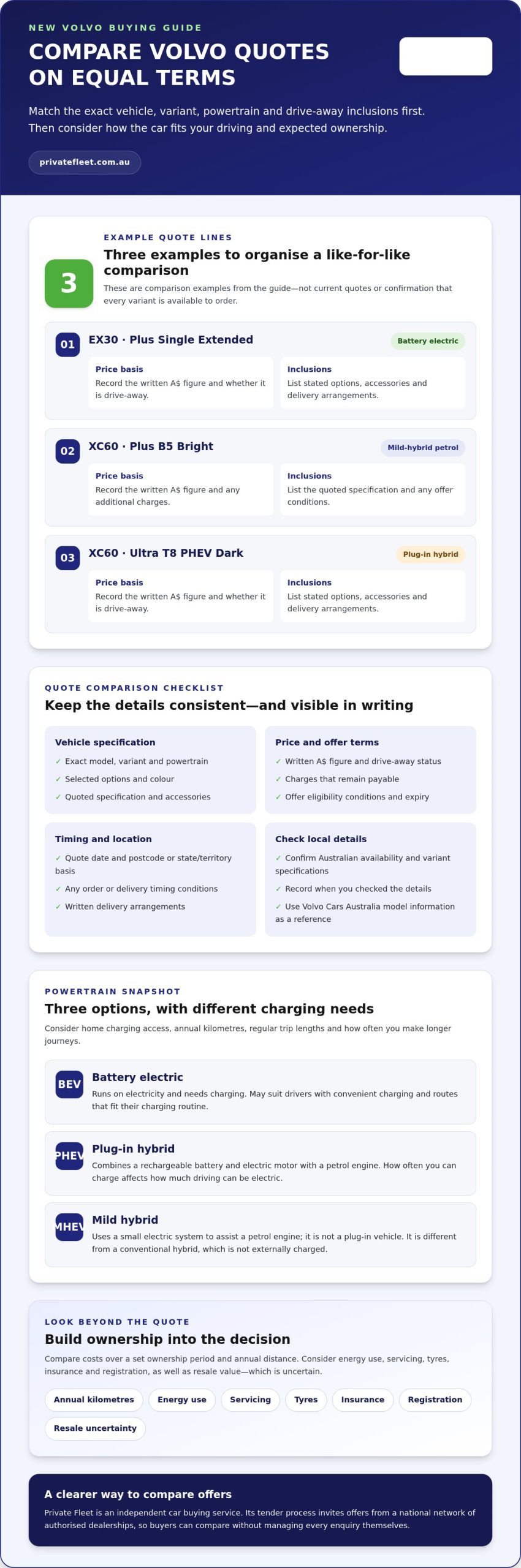
A fair comparison starts with the same Australian vehicle specification and a clear price basis. Two headline figures aren’t directly comparable if one is for a different variant, excludes on-road costs or depends on an offer with conditions. Ask for each offer in writing, then check what the quoted amount covers before deciding which represents the better fit.
What should a like-for-like Volvo quote include?
Record the exact model, variant and powertrain, plus any selected options and colour. Confirm whether the price is drive-away or whether charges remain payable. If the figure depends on an offer, note its eligibility conditions and expiry alongside the quote date. This makes it easier to spot differences in specification, timing or inclusions before comparing totals.
Use a table like this to organise written offers. These are example models and comparison fields, not current quotes or a claim that every variant is available to order. Check the Volvo Cars Australia model range and specifications for current local details before requesting offers.
| Model | Variant | Powertrain | Price basis | Inclusions |
|---|---|---|---|---|
| EX30 | Plus Single Extended | Battery electric | Record the written A$ figure and whether it is drive-away | List stated options, accessories and delivery arrangements |
| XC60 | Plus B5 Bright | Mild hybrid petrol | Record the written A$ figure and any additional charges | List the quoted specification and any offer conditions |
| XC60 | Ultra T8 PHEV Dark | Plug-in hybrid | Record the written A$ figure and whether it is drive-away | List stated options, accessories and delivery arrangements |
Confirm model names, variant specifications and Australian availability when you request quotes, and record the date checked. Also note the quote date, postcode or state and territory basis, offer expiry, and any conditions such as order or delivery timing. Identify whether a price is drive-away in the written offer; don’t assume a list price includes the same items.
How can dealer offers be compared without guesswork?
Keep the vehicle specification consistent and ask for itemised written offers. Note any difference in accessories, delivery arrangements or offer conditions rather than treating the lowest headline figure as the full comparison. Assess a discount or special offer against its stated terms and expiry, not as something that necessarily applies to every vehicle or buyer.
- Match model, variant, powertrain and options across offers.
- Record the quoted A$ amount, price basis, inclusions and remaining charges.
- Keep the trade-in valuation separate from the new-car price, then compare the changeover amount.
- Save each offer with its date, location basis and expiry or conditions.
Private Fleet is an independent vehicle sourcing and car buying service, not a Volvo dealer or vehicle inventory holder. Through its national network of authorised dealerships, a tender process invites multiple dealers to compete for your business. Its new-car buying service can help you compare offers without managing every enquiry directly. If you’d like support, Get help buying my new car by sharing your preferred model, postcode and buying timeframe.
What Does It Cost to Own a New Volvo Over Time?
A useful ownership estimate compares the same period and distance for each vehicle. Choose an intended ownership period, such as five years, and an annual distance that reflects your driving. Then add the costs you expect to pay and subtract an estimated resale value. Treat the result as a planning estimate, not a prediction of what the car will be worth.
Which costs belong in a Volvo ownership estimate?
Use current Australian quotes, bills or clearly stated assumptions for each cost. Include the purchase price, estimated resale, energy, scheduled servicing, tyres, insurance and registration. If considering an electric Volvo, include any home charging installation cost relevant to your circumstances. If you’re financing the purchase, add interest and fees over the chosen period, but don’t add the loan principal again: the purchase price already accounts for the car itself.
Keep the manufacturer’s service schedule separate from the estimated amount you expect to spend. The schedule tells you when servicing is due; a current service-plan price or written service estimate helps quantify it. Volvo Australia’s published information states that service intervals are typically every 12 months or 15,000 kilometres. Check the schedule and applicable plan terms for the exact model and powertrain before using them in a calculation.
Resale is uncertain. Build low, base and high resale assumptions from relevant Australian market information, then calculate each scenario separately. A lower resale assumption increases estimated ownership cost; a higher one reduces it. Don’t present any scenario as a guaranteed future value.
How should powertrain costs be compared fairly?
For a battery electric vehicle, record your home and public charging mix, the A$ per kilowatt-hour for each, and an allowance for charging losses. For a petrol mild hybrid, use the relevant fuel price and consumption assumption. For a plug-in hybrid, estimate the share of kilometres driven using electric power, then calculate charged and depleted-battery use separately. Don’t compare a PHEV’s charge-weighted laboratory consumption directly with a conventional hybrid’s figure.
Manufacturer consumption and range figures are laboratory results, not guaranteed real-world outcomes. Keep them labelled as such, and make any real-world estimate a separate assumption based on your routes and driving conditions. To buy a new Volvo Australia compare ownership costs and new car quotes consistently, use the same kilometres, period and energy-price assumptions for each candidate, and record where each input came from and when you checked it.
For an EV estimate, Private Fleet’s electric vehicle resources can help you consider charging and electric-car use alongside your own cost inputs. Update those inputs if your driving, energy tariff or intended ownership period changes; a clear set of assumptions makes the comparison easier to revisit.
How Do Warranty, Servicing and Everyday Comfort Affect the Decision?
Warranty terms and the feel of the car in daily use can matter as much as the quote. Compare the written Australian warranty for the exact vehicle, then try the variant yourself. A feature that sounds useful on paper may not suit your preferences if the controls, visibility or seat adjustment feel awkward in practice.
What warranty and servicing terms should you verify?
Volvo Australia’s published terms, checked in October 2026, state that new vehicles sold from 1 April 2020 for private use have a five-year, unlimited-kilometre vehicle warranty. The high-voltage battery warranty is separate: it covers material defects for eight years or 160,000 kilometres, whichever comes first, and doesn’t cover normal, gradual capacity loss. These are distinct protections, not a promise that battery capacity will remain unchanged.
Before relying on those terms, read the current Australian warranty booklet for the vehicle you’re considering. Check exclusions, required servicing, claim conditions and whether the cover transfers to a later owner. Don’t assume the battery warranty and vehicle warranty have identical conditions. Record the document’s date and the date you checked it, as terms can change.
Compare scheduled servicing requirements with the current service-plan terms for the same model and powertrain. Look at what routine servicing covers, what is excluded and whether any plan must be purchased by a certain point in the vehicle’s service schedule. A fixed-price plan can help make scheduled servicing more predictable, but its inclusions should be weighed against your expected ownership period.
Which everyday details are worth comparing in person?
Take time in the exact variant you intend to quote. Adjust the driver’s seat and steering wheel, check the view over your shoulder and assess how comfortably you can get in and out. If possible, drive on familiar road types and listen for cabin noise at the speeds you regularly travel. Your own comfort matters more than a general claim about any model.
- Controls: Try common tasks using both physical switches and the touchscreen. Consider whether key settings are easy for you to find.
- Parking: Test the visibility and any fitted parking assistance in a suitable setting.
- Safety: Check the exact variant’s Australian specification for included safety features rather than assuming they’re uniform across the range.
- Ride: Notice how the car feels over the road surfaces you commonly use.
Use reviews as context, not a substitute for checking the exact car. Private Fleet’s car reviews can help you form questions; check the review’s model year and specification against the current Australian vehicle.
| Priority | Potential advantage | What to weigh |
|---|---|---|
| Predictable cover | Published warranty periods clarify the stated coverage window. | Exclusions, conditions and transfer terms still matter. |
| Everyday comfort | A personal drive helps assess fit and usability. | Seat, visibility and control preferences differ by driver. |
Compare the warranty and the drive experience together; both help you judge whether a Volvo fits the way you plan to use and keep it. They add useful context as you buy a new Volvo Australia compare ownership costs and new car quotes.
How to Move from a Volvo Shortlist to a New Car Purchase
Once you’ve narrowed your choices, move from research to a decision in sequence: settle on a preferred model and variant, compare written offers, assess any trade-in separately, then decide whether to proceed. Keeping these steps distinct helps you understand the vehicle offer before weighing the overall changeover cost.
Before committing, revisit the details that could change your choice: the exact specification, price basis, offer conditions and estimated ownership costs. If you’re still deciding between two options, record what matters most and compare them against the same priorities. A lower purchase figure alone won’t show whether a different variant better suits your driving or intended ownership period.
What information helps progress a Volvo enquiry?
A clear brief gives the buying process a practical starting point. Share your preferred Volvo model and variant, your shortlist, budget basis and buying timeframe. Include your postcode so offers can be considered in the relevant quote context, without assuming a particular local market. If you have a trade-in, say so; keep its valuation distinct from the new-car price when reviewing the changeover.
- Vehicle: preferred model, variant, powertrain and any alternatives you’d consider.
- Budget: the amount you’re planning around and whether you’re comparing drive-away offers.
- Use: approximate annual kilometres and, for an electric or plug-in hybrid, access to home charging.
- Timing: your intended buying timeframe and any trade-in requirement.
This detail helps focus the comparison on options that fit your needs. If you want to buy a new Volvo in Australia, comparing ownership costs and new car quotes is straightforward when you provide your shortlist and assumptions so offers can be evaluated on a consistent basis.
What happens between comparing offers and taking delivery?
Private Fleet is an independent Australian vehicle sourcing and car buying service. It works with a national network of authorised dealerships, where a tender process invites multiple dealers to compete for your business. Private Fleet assists with sourcing and new-car purchase, but doesn’t hold vehicle inventory or act as a Volvo-authorised dealer. You decide which written offer, if any, suits you.
If you’re trading in, consider the trade-in offer separately from the new-car quote, then review the resulting changeover amount. Before accepting an offer, read its written terms and check that the vehicle specification, price basis and any conditions match your understanding. The relevant dealer handles the vehicle order; order status and delivery timing depend on the dealer and vehicle, so don’t treat an estimate as a guaranteed date.
The new-car buying process explains how Private Fleet supports buyers through sourcing and purchase. With your preferred model, postcode, timeframe, shortlist, annual kilometres and charging access ready, you can take a clear next step.
Get help buying my new car
Make your Volvo shortlist work for you
Your next step is to turn your shortlist into a clear buying brief. Decide which model and variant you’d choose first, what alternatives you’d consider, and what matters most if the offers differ. A firm set of priorities makes it easier to recognise an offer that fits your plans, rather than being drawn only to a headline figure.
If you’re ready to buy a new Volvo Australia compare ownership costs and new car quotes with the same vehicle details and realistic driving assumptions. Share your preferred model, postcode, buying timeframe, annual kilometres and charging access, along with any trade-in requirements. That gives the conversation a useful starting point and helps keep the next steps focused on your needs.
You can take the time you need to make a considered choice. A well-defined brief puts you in a stronger position to compare options calmly and proceed when the right fit becomes clear.
Get help buying my new car
Frequently Asked Questions
Can a Volvo warranty transfer to a new owner in Australia?
It may, but check the Australian warranty booklet for the specific vehicle rather than assuming cover transfers automatically. Look for any transfer conditions and whether servicing or documentation requirements apply. If you’re buying a demonstrator or a vehicle that has already had an owner, ask for the warranty start date and relevant service records so you can understand how much cover remains and what conditions continue to apply.
Do Volvo plug-in hybrid fuel figures include charging?
Some published plug-in hybrid figures combine petrol use with electricity used during a test, so a low fuel figure doesn’t necessarily describe driving with a depleted battery. Check the Australian specification for both the stated fuel consumption and electricity consumption, and note the test basis. For your own estimate, consider how often you can charge and what share of your kilometres might be driven electrically.
Can I compare a Volvo quote with an advertised offer online?
Yes, if the offer applies to the same Australian model, variant and powertrain as your quote. Check its price basis, eligible buyers, order or delivery dates, location terms and listed inclusions. Save the offer details and expiry date, then compare them with the written quote. If the advertised promotion is conditional or excludes items included in the quote, adjust your comparison before judging the difference.
Should I include my trade-in when comparing new Volvo quotes?
Include it when assessing your overall changeover, but keep its valuation separate from the new-car price. This helps you see whether a difference comes from the Volvo offer or the amount allowed for your current vehicle. Share accurate details about its model, variant, kilometres and condition when requesting a valuation; then compare the trade-in figure and new-car quote as separate parts of the transaction.
How should I compare Volvo battery warranty with vehicle warranty?
Compare the two as separate protections. The vehicle warranty covers eligible faults under its terms, while the high-voltage battery warranty has its own scope, limits and exclusions. Volvo’s published Australian terms distinguish material battery defects from normal gradual capacity loss. Read the current booklet for the exact vehicle and check any capacity commitments, service conditions and transfer rules; don’t assume battery cover guarantees a particular driving range.
What should I provide when asking for help buying a new Volvo?
Share your preferred model and variant, shortlist, postcode, budget basis and buying timeframe. Add approximate annual kilometres, whether you have a trade-in, and your charging access if you’re considering an electric or plug-in hybrid. If you’re planning to buy a new Volvo in Australia, compare ownership costs and new-car quotes using consistent details so the offers reflect vehicles that suit your priorities.